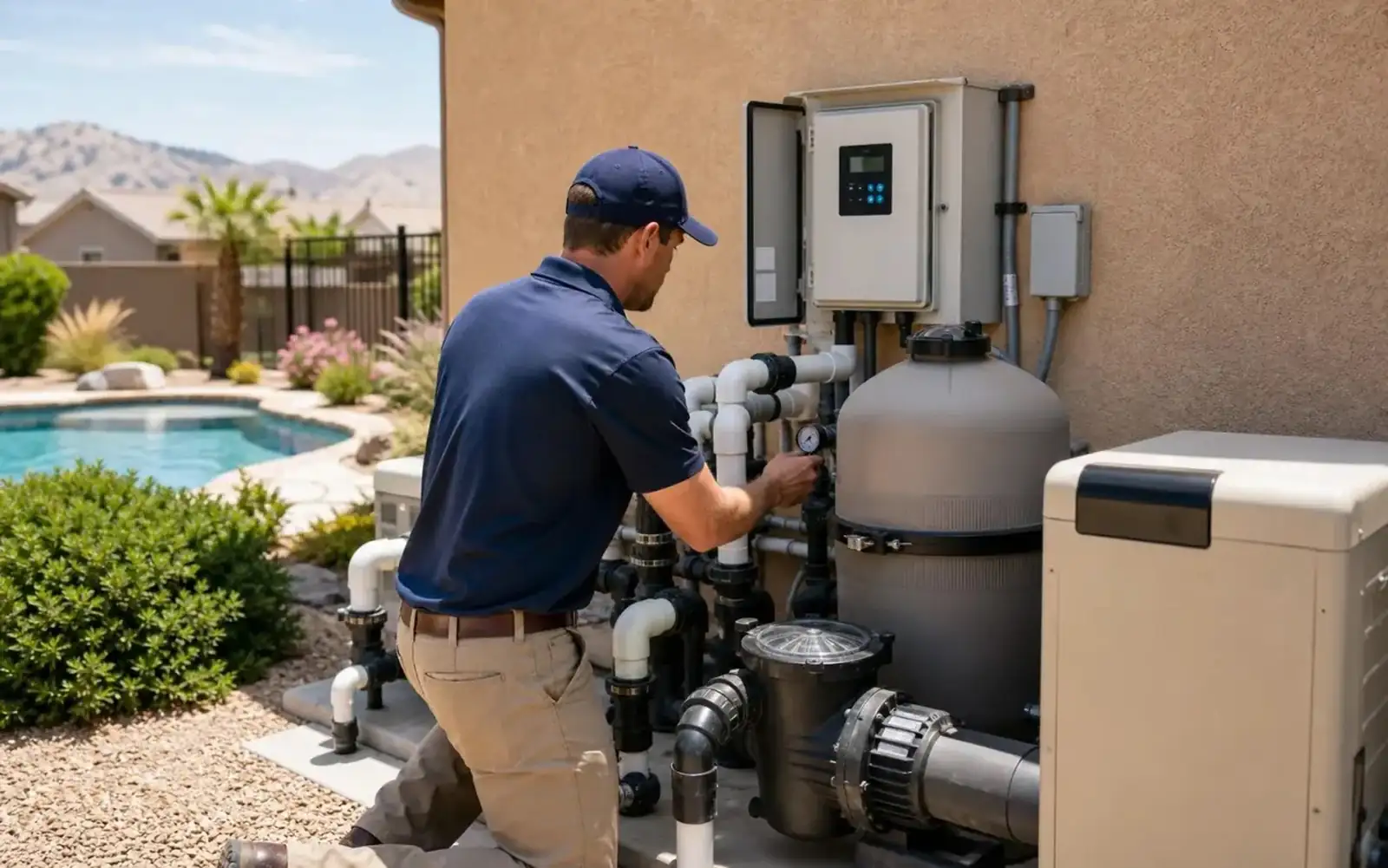
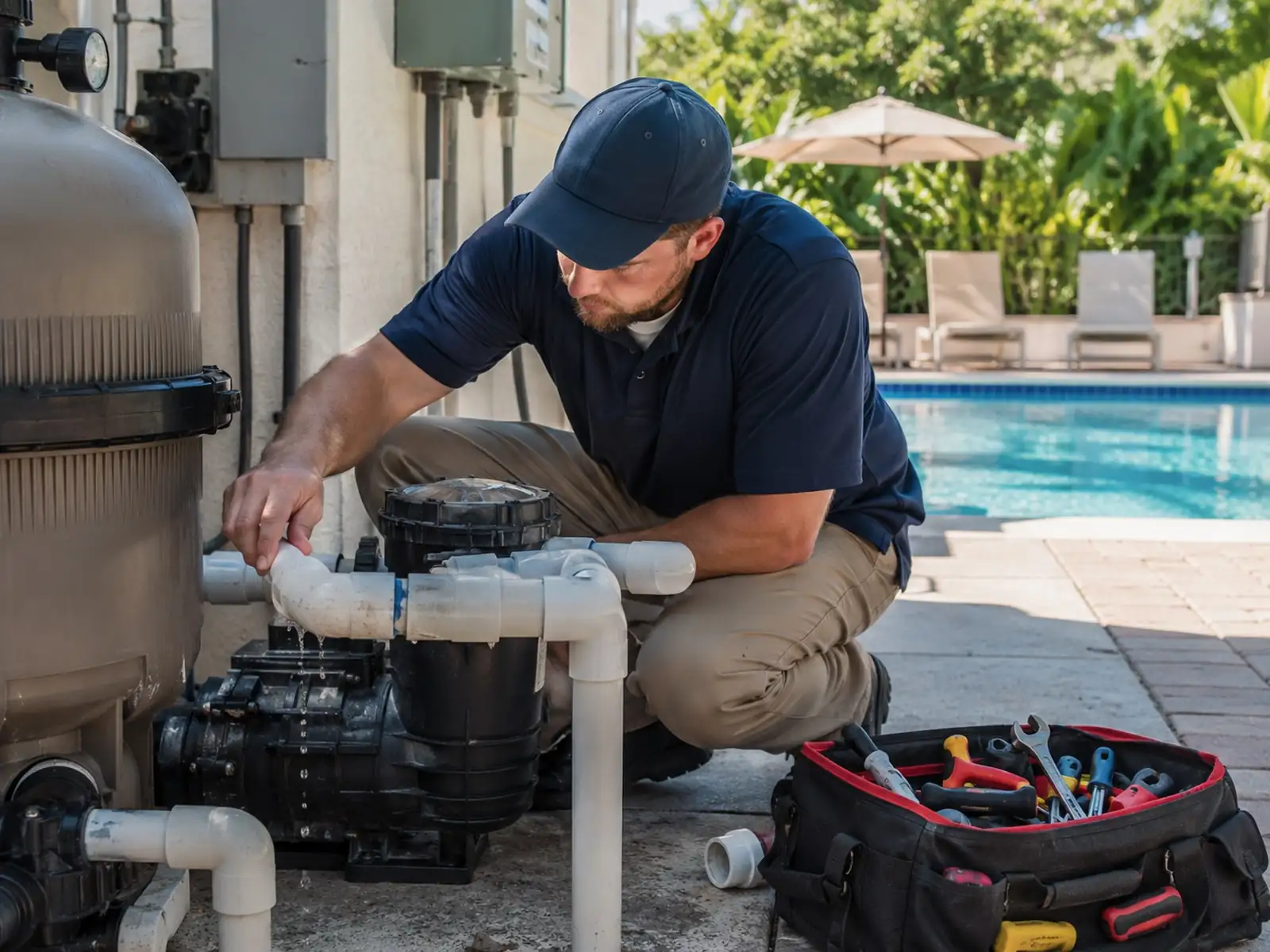

Pool Equipment Installation
Pool equipment installation
New equipment has to fit the plumbing, the electrical supply and the pad it joins. That is why installation starts with looking at what is there.
Upfront pricing · many common repairs and installations have a set price, given before any work starts
What we install
Installation, replacement and upgrade work across every category on the equipment pad. Each category has its own page with the detail — this page is the map.
Pumps and circulation
- Pool pump installation — motor installation and full pump replacement
- Variable-speed pump installation — including upgrades from single-speed
- Filter installation — replacements, sand changes and multicyclone installation
- Valve and actuator installation — including adding automatic valves where the pad supports it
Heating
Gas heaters and heat pumps are covered as a diagnostic: the pool heater diagnostic and pool heat pump diagnostics establish what has failed and what putting it right involves, and anything beyond that is quoted afterwards.
Sanitation
- Salt system installation — sized to the pool and the actual run time
- Chlorine feeder installation — where a feeder suits the pool better than a salt system
- Salt cell replacement — covered on the salt system page
Automation and accessories
- Automation panel installation — panels, relays and actuators
- Time-clock installation — the simpler alternative where full automation isn't wanted
- Automatic pool-cleaner installation
- Spa-blower installation
Deciding what to install
- Equipment replacement and upgrades — the repair-or-replace conversation
- New-equipment evaluations — what condition the pad is actually in, before a failure forces the decision
How an installation starts
With a site evaluation, and it is not a formality. The pad tells us most of what we need:
- Plumbing. Pipe size and layout decide what a pump or filter can do once it is installed.
- Electrical supply. Circuit size and available capacity constrain pumps, heat pumps and automation.
- Gas capacity. For a gas heater this is the constraint that most often surprises people, because a heater larger than the gas line can feed performs worse than a correctly sized one.
- Physical space and airflow. Heat pumps in particular need open air around them.
- What the new unit has to work alongside, especially where a control system is involved.
Those constraints usually narrow the sensible options before preference does. We would rather tell you that at the start than after something is ordered.
Sizing
The most common problem we see on an existing installation has nothing to do with the brand. It is the size.
Undersized equipment runs at full output constantly and wears out early. Oversized equipment is not the safe alternative it sounds like: an oversized heater short-cycles, an oversized pump moves water faster than the plumbing was built for, and both cost more to run while lasting less time.
Sizing is done against your pool's actual volume, your actual plumbing, and how long the pump really runs. Not against a table.
Pool school
When new equipment goes in, we walk you through operating it — what the controls do, what normal looks like on the gauges, and what to watch for.
Establishing your new filter's clean pressure at handover, for instance, turns the gauge from decoration into the most useful diagnostic on the pad for as long as you own it.
Warranty service
We perform warranty service on equipment where the manufacturer's process provides for it. Coverage, duration and conditions are set by the manufacturer rather than by us, so we do not describe warranty terms here — we will tell you what applies to your specific unit.
What an installation includes
- Sizing against the pipework, the turnover the pool needs, and everything downstream that sets a minimum flow — heater, salt cell, cleaner, water feature
- The plumbing modification the new unit needs to land on the existing pad
- Electrical connection and bonding at the equipment
- Commissioning: primed, valves set, schedule programmed, and walked through with you
Where we work
Queen Creek · Gilbert · Chandler · Mesa · San Tan Valley · Apache Junction · Gold Canyon · Florence · Anthem at Merrill Ranch
Set prices
- Pump installation$225 labor
- Filter installation$225 labor
Labor prices don’t include the pump, filter or parts, which are quoted with the job. You hear the full price before any work starts. Not sure what’s wrong? That’s the $120 diagnostic, credited toward your repair if you go ahead.
Why homeowners call us
You approve the price first
Whether we are diagnosing a fault or doing a job you already know you need, you hear the price before any work starts. Nothing is replaced until you have approved it.
Pool equipment is all we work on
Pumps, motors, filters, salt systems, automation and the plumbing at the pad. The technician who diagnoses it is the one who fixes it.
Upfront pricing
Already know what you need? Many common repairs and equipment installations have a set price, and you hear it before any work starts. The $120 diagnostic doesn't automatically apply to those jobs.
Questions we get asked
Do you install equipment I've bought myself?
That depends on what it is and whether it suits the pad. It is worth asking before you buy — the common problem with owner-supplied equipment isn't the equipment, it's discovering after purchase that the electrical supply or the plumbing won't take it.
Why do you want to see the pad before quoting?
Because the pad decides most of it. Pipe size, electrical supply, gas capacity, physical space and what the new unit has to work alongside all constrain the sensible options. A quote given without seeing those is a guess that gets corrected later, usually upward.
Can you install one piece at a time?
Yes, and often that is the right approach. Equipment installed together tends to reach the end together, so it's worth knowing what else is close — but knowing is not the same as replacing, and sequencing it is a legitimate choice.
Do you handle permits?
What a particular installation requires depends on the jurisdiction and the scope of work. We establish that for your address rather than making a blanket assurance on a web page, and we will tell you plainly what applies before work starts.
Tell us what it’s doing.
A few questions is usually enough to tell a five-minute fix from a real repair.