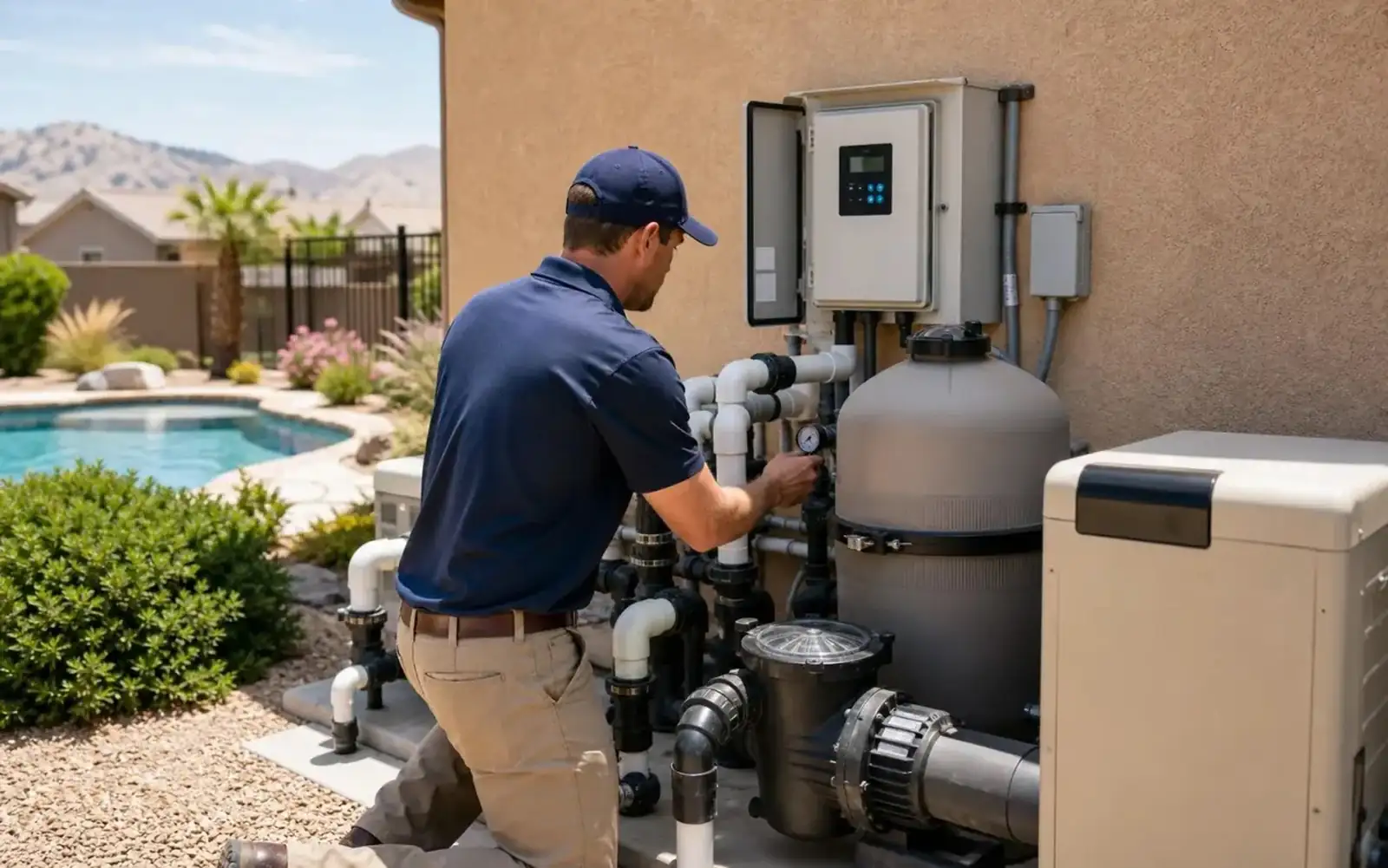
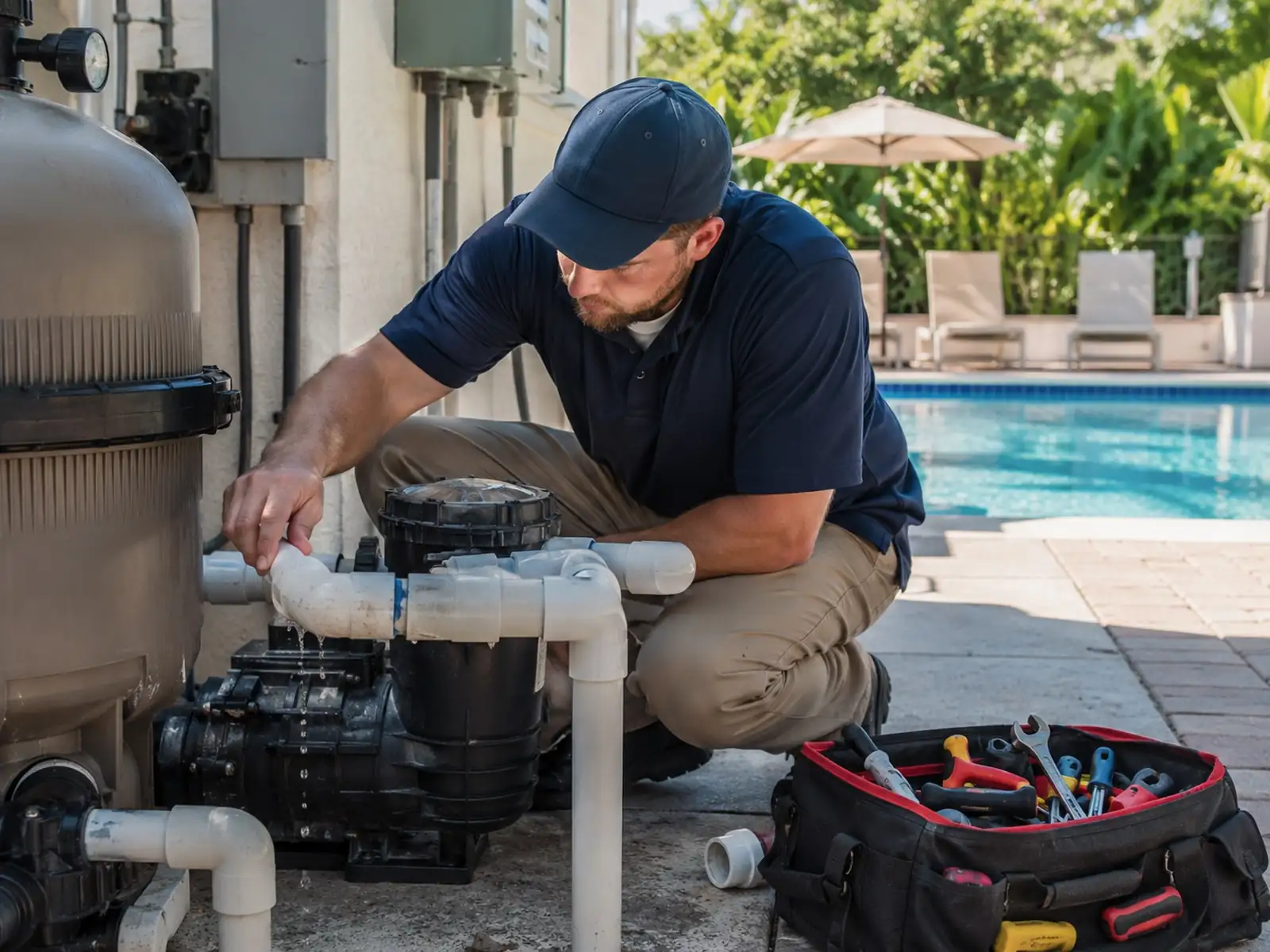

Pool Filter Repair & Installation
Pool filter repair
The filter is the most common reason a healthy pump moves no water — which is good news, because it is the cheaper half of the pad.
$120 diagnostic, credited toward your repair · set pricing on many common repairs and installations
The pressure gauge is the most useful thing on the pad
Not because a number is meaningful on its own — it is not — but because the change is. A filter has a normal clean pressure. Everything diagnostic about a filter is the current reading compared to that.
- Higher than normal, weak return flow — restriction in the filter. Dirty or failed element.
- Lower than normal — the problem is upstream. The filter is not getting water, which points at the suction side or the pump.
- Normal, weak flow — something after the filter, or a flow problem that pressure will not show.
If nobody has ever told you your filter's clean pressure, that is worth establishing. It turns the gauge from decoration into an instrument.
What we repair
- Cartridge elements that have collapsed, channelled, or reached the end of their life
- DE grids and manifolds
- Sand filters with channelling, a failed lateral, or a valve problem
- Multiport and slide valves that leak or bypass
- Tank clamps, bands and o-rings
- Housings that have cracked — most often from over-pressurisation or age in Arizona sun
The safety part
A filter is a pressure vessel. Opening one that still holds pressure is genuinely dangerous, and the air relief valve exists precisely for this. It is the one piece of pool equipment where we would rather you did not experiment.
Cleaning a cartridge is homeowner work. Opening the tank when the gauge is not reading zero is not.
Cleaning is not the same as repair
Most filter calls are maintenance, and much of it you can do. Where it stops being maintenance:
- The element is clean and pressure is still high
- Pressure climbs again within days of a clean
- Debris returns to the pool through the returns
- The tank leaks from a seam rather than a fitting
Those are repair problems.
Filter service and installation
Alongside repair, the routine work a filter actually needs:
- Filter cleaning — a proper element clean, which is not the same as a hose-down and is the single most-deferred job on most pads.
- Sand changes — sand does not last forever. Channelled or hardened sand filters worse than fresh sand no matter how good the filter is.
- Element and cartridge replacement — when cleaning stops restoring pressure, the element is done.
- Multicyclone installation — pre-filtration that takes load off the main filter, which extends element life and lengthens the interval between cleans.
- Full filter replacement — where the body has failed or the filter is undersized for the pool.
Sizing is the thing most often wrong. An undersized filter runs at high pressure its whole life, needs cleaning constantly, and wears elements out early. Replacing one with the same size perpetuates the problem, so it is worth checking rather than matching.
Related
Pool pump running but no water flow · Pool equipment diagnostics · Pool pump repair
Set prices
- Filter installation$225 labor
- Filter cleaning$140 labor
Labor prices don’t include the pump, filter or parts, which are quoted with the job. You hear the full price before any work starts. Not sure what’s wrong? That’s the $120 diagnostic, credited toward your repair if you go ahead.
Why homeowners call us
You approve the price first
Whether we are diagnosing a fault or doing a job you already know you need, you hear the price before any work starts. Nothing is replaced until you have approved it.
Pool equipment is all we work on
Pumps, motors, filters, salt systems, automation and the plumbing at the pad. The technician who diagnoses it is the one who fixes it.
Upfront pricing
Not sure what's wrong? A $120 diagnostic finds it, and the $120 is credited toward your repair if you go ahead. Many common repairs and installations have a set price instead.
Questions we get asked
My filter pressure is high. Is that bad?
High pressure with weak return flow means water is getting into the filter and struggling to get out — usually a dirty or failed element. What matters is the reading compared to the filter's own normal clean pressure, not any particular number.
Can a filter cause a pump problem?
Yes, and the reverse. A badly restricted filter makes the pump work against pressure it was not designed for. Diagnosing them separately is how people replace the wrong thing.
Should I upgrade my filter?
Only if it is undersized or failing. A correctly sized filter in good condition does not need improving.
Tell us what it’s doing.
A few questions is usually enough to tell a five-minute fix from a real repair.