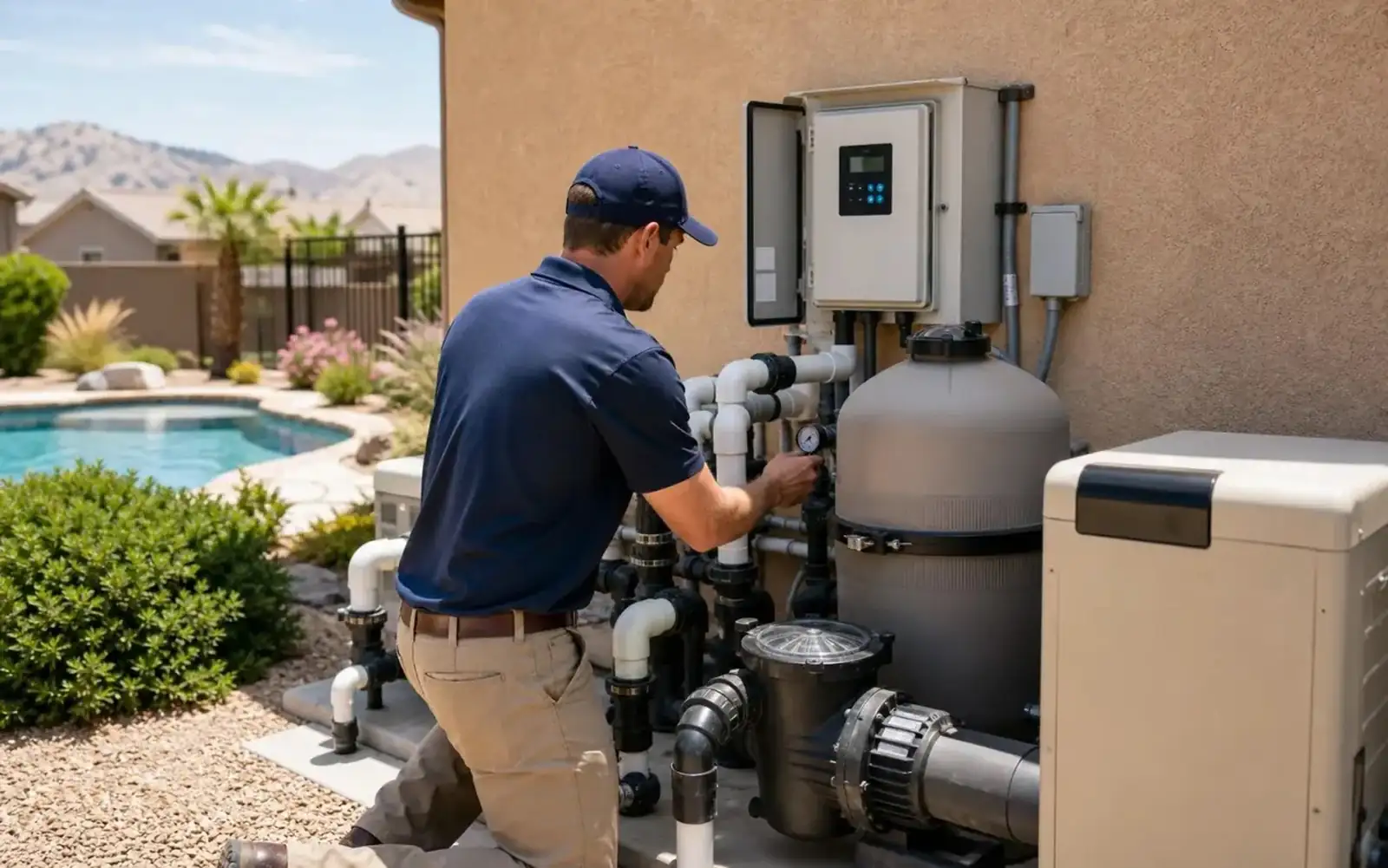
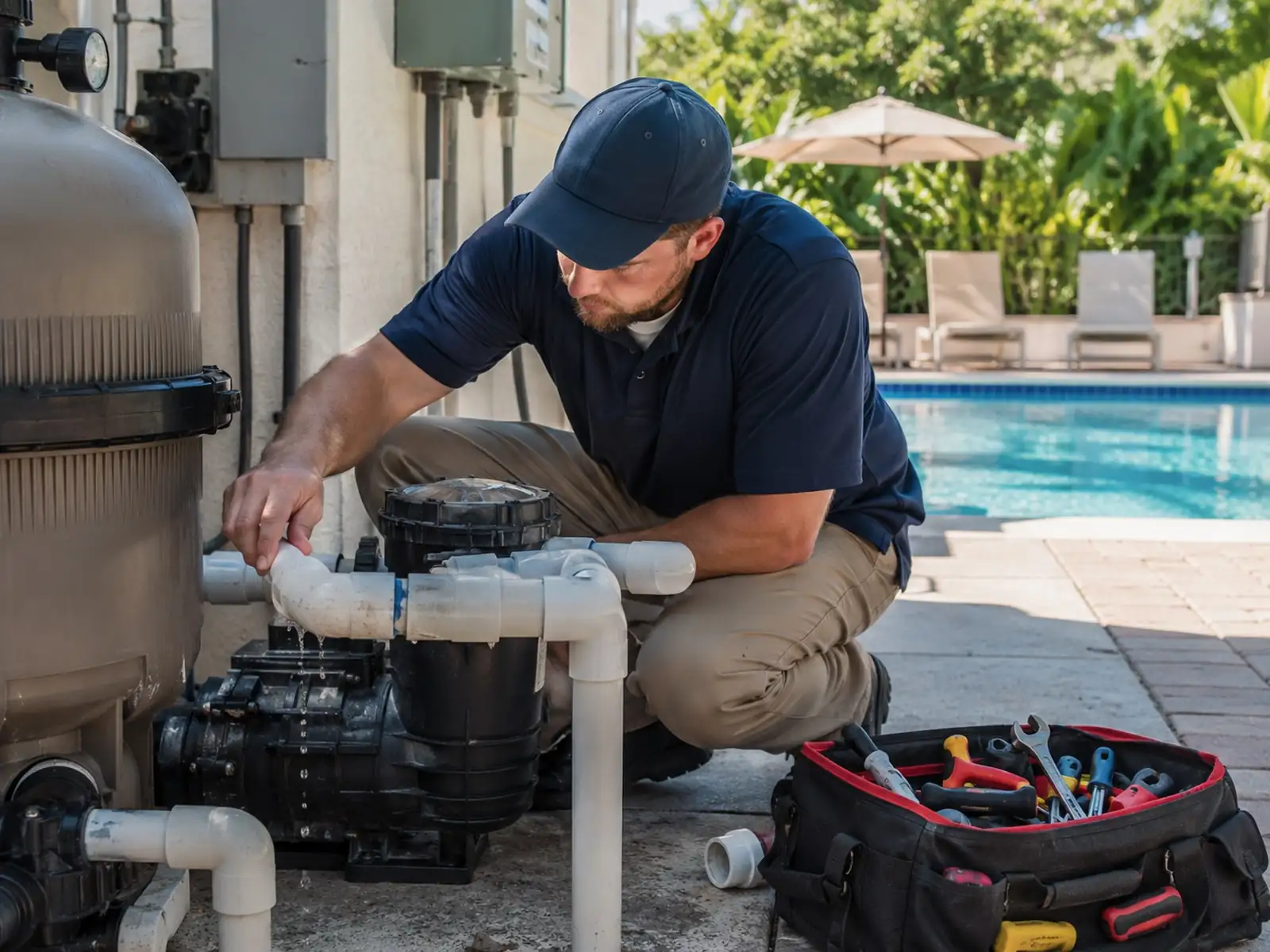

Heaters & heat pumps
Pool heater not heating
Most pool heaters that won't heat are refusing to run because a condition they check for isn't met, usually water flow. These are the checks Pentair and Hayward put first, which ones are safe to do yourself, and where to stop.
$120 diagnostic, credited toward your repair · set pricing on many common repairs and installations
A pool heater that won't heat is usually not broken. Gas heaters and heat pumps both check for certain conditions before they run, and when one of those checks fails, they stay off. Water flowing through the heater is the condition that fails most often. The manufacturer guides start there for that reason: Pentair's MasterTemp troubleshooting section begins by having you confirm that the pump is running, nothing is blocked, the valves are set correctly and the time clock is running (Pentair MasterTemp manual, p. 48).
This guide covers the checks you can safely do yourself and how they differ between a gas heater and a heat pump. It also covers the point where you should stop and leave the heater off.
Safety first
If you smell gas, leave the area and call your gas utility from a safe place, before anything else. Pentair's instructions are specific. Don't try to light any appliance, don't touch any electrical switch, don't use a phone inside the building, and call the gas supplier from a neighbor's phone. If you can't reach the gas supplier, call the fire department (MasterTemp manual, p. 42). Once the utility has made it safe, the heater can be diagnosed.
Everything in this guide is done from outside the heater. Stop at the cabinet. Inside are gas controls, line voltage and hot surfaces. Pentair's troubleshooting pages warn against jumpering switch terminals to get around a failed safety switch (MasterTemp manual, p. 49), and those switches are there to keep the heater from running when it isn't safe.
Which kind of heater do you have?
- Gas heater. It burns natural gas or propane, has a gas line running to it and vents exhaust. Examples are Pentair MasterTemp and Hayward Universal H-Series.
- Heat pump. It runs on electricity and has a large fan on top that blows air out. It heats the water with heat taken from the outdoor air. Examples are Pentair UltraTemp and Hayward HeatPro and Summit.
If you aren't sure, check the label on the unit, or note whether a gas line runs to it. The first few checks below apply to both kinds.
Checks for any pool heater
1. Is the pump running?
Neither kind of heater runs without water moving through it. Hayward's heat pump guide says plainly that its heat pumps won't run when the pool pump is off (Hayward heat pump guide, p. 6). On a Hayward H-Series gas heater, the LO code is normal when the pump is turned off (Hayward H-Series guide, p. 48).
Also check the schedule. Hayward lists time clocks in their off cycle among the most common causes of its heat pump flow codes (Hayward heat pump guide, p. 33). If the pump's schedule ends at 4 p.m., the heater stops heating at 4 p.m.
2. Is enough water getting through?
A running pump doesn't guarantee enough flow. Every heater has a pressure or flow switch that has to close before it will fire, and each manufacturer publishes a minimum flow:
- Pentair MasterTemp: from 20 gallons per minute on the 175 and 200 models up to 40 on the 400, with a maximum of 120 (MasterTemp manual, p. 14 and p. 51).
- Hayward Universal H-Series: the minimum depends on the model, and the maximum is 125 gallons per minute (Hayward H-Series guide, p. 61).
- Hayward heat pumps: a minimum of 30 gallons per minute. Hayward notes that more may be needed at higher water and outdoor temperatures, such as when heating a spa (Hayward heat pump guide, pp. 25-26).
Things you can check without tools:
- Skimmer and pump baskets. Empty them.
- The filter. If the pressure gauge reads higher than usual, the filter may need cleaning. Pentair's guidance for the MasterTemp flow error is to clean the filter and skimmers first, and to backwash if your filter type calls for it (MasterTemp manual, p. 45).
- Pump speed. On a variable-speed pump, a low-speed program can run all day without moving enough water for the heater's switch to close. Look at the speed the pump is running while the heater should be heating.
3. Are the valves sending water through the heater?
Valves get moved for spa mode, for a cleaner, or just to see what they do. Pentair's UltraTemp guide lists an open external bypass around the heat pump as a cause of its LOW WATER FLOW alarm (UltraTemp manual, p. 27). Hayward names open bypass valves as a leading cause of its heat pump flow codes (Hayward heat pump guide, p. 33). If someone changed valves recently, put them back the way they were.
4. Is the setpoint above the water temperature?
A heater only fires when its setpoint is above the actual water temperature. Pentair's operating instructions call this out directly (MasterTemp manual, p. 43). Check both pool and spa modes, because each has its own setpoint.
Next, check the heater's maximum temperature limit. Hayward's Universal H-Series has a temperature lock-out that defaults to 90°F for the pool and 104°F for the spa (Hayward H-Series guide, p. 14). The MasterTemp has adjustable POOL MAX and SPA MAX settings in its menu (MasterTemp manual, p. 47). A pool that always stops at the same temperature is often hitting this limit.
5. Is automation in charge?
If your heater is controlled by an automation system or a remote, the heater's own display may not tell the full story:
- A Hayward H-Series heater shows bo when it has been put in bypass mode for external control (Hayward H-Series guide, p. 13). In that mode the automation system decides when the heater runs.
- A Hayward square-platform heat pump wired to a remote shows FLo whenever the remote isn't calling for heat (Hayward heat pump guide, p. 13). That is normal and doesn't mean a flow problem.
6. Does it have power?
A heat pump with a blank display has no low-voltage power at its control, and Hayward names a tripped breaker as a likely cause (Hayward heat pump guide, p. 34). You can look at the breaker. If the breaker trips again after being reset once, leave it off. A breaker that keeps tripping is protecting something.
Gas heater: it won't light, or it lights and shuts off
Check the gas supply first. If the stove, water heater or other gas appliances are also out, the problem is with the gas supply rather than the heater. Hayward's troubleshooting for its IF (ignition failure) code starts by confirming that the main gas supply is on, and then that the heater's own gas valve is on (Hayward H-Series guide, p. 54). That second valve is inside the cabinet, so leave it to a technician.
After repeated failed lights, a heater locks itself out. A Hayward H-Series heater tries three times, shows IF, waits 60 minutes and tries again, and keeps retrying every 60 minutes for as long as there is a call for heat (Hayward H-Series guide, p. 8). So a heater that seems dead may simply be waiting before its next try.
Write down the code exactly as it appears. The MasterTemp keeps its last five errors in a HISTORY menu (MasterTemp manual, p. 47), which helps when a code comes and goes. The two code guides below cover each manufacturer's list:
Some codes mean the heater should stay off. Pentair's manual says not to operate a MasterTemp showing ERR HLS, ERR AFS, ERR IGN, ERR AGS, ERR SFS, E01, E05, E06 or 126. It says to shut the heater down and have a qualified service technician check the system (MasterTemp manual, p. 45). Cycling power repeatedly to clear one of these codes works against the safety system.
A heater that sits unused through an Arizona summer often gets its first call for heat in the fall. If it fails to fire then, start with the checks above before assuming a part has failed.
Heat pump: it runs, but the water stays cold
Give it a few minutes. Hayward heat pumps wait before starting, three minutes on square units and five on round ones. The delay restarts every time power is interrupted (Hayward heat pump guide, p. 6).
Feel the air coming off the top. A heat pump that is heating blows out air noticeably cooler than the air around it. Hayward gives 15-20°F as the normal difference and calls it the best way to tell whether a heat pump is heating. Low humidity and cooler weather can reduce that difference (Hayward heat pump guide, p. 7). Feel the air from beside the unit and keep your hands away from the fan.
Defrost is normal on cold mornings. When the outdoor air is in the low-to-mid 50s or colder, a Hayward heat pump may show FS or deF while the compressor rests and the fan keeps running. Hayward describes this as normal. If the code appears in warmer weather, the defrost sensor may be the problem (Hayward heat pump guide, p. 35). Cold desert mornings can put the unit in defrost even when afternoons are mild.
Keep the area around it clear. Pentair's owner inspection list for the UltraTemp says to keep the top and surroundings free of debris, keep plants and shrubs trimmed back, and keep sprinklers from spraying the unit (UltraTemp manual, p. 24).
Water on the pad may be condensation. Heat pumps pull moisture out of the air while they run. Hayward gives two ways to tell: a leak keeps dripping when the unit is off, and a chlorine test strip shows little or no chlorine in condensation (Hayward heat pump guide, p. 8).
When to stop
Stop, leave the heater off, and get it diagnosed if:
- You smell gas. Leave the area and call your gas utility first.
- A gas heater shows one of the fault codes its manufacturer says not to operate it with.
- A breaker trips again after one reset.
- The heater makes unusual noises, or you see soot, scorching or melted wiring.
- The pump is running, the filter is clean, the valves are right and the setpoint is above the water temperature, but the flow or pressure code is still there.
- The next step would mean removing a panel.
What a heater diagnostic establishes
Mobile Pool Repair's heater diagnostic starts with the conditions above, because those are what a heater checks before it runs. The technician reads the heater's code against that manufacturer's documentation, measures the flow through the heater, checks the pump speed and schedule behind that flow, and checks the filter and valve positions on the pad. On a heat pump, the visit also covers the fan, capacitor, sensors, board and switches, and the clearance around the air intake and discharge.
You get a clear answer on what has failed and what fixing it involves before any work is decided. A diagnostic is $120, and the $120 is credited toward your repair if you go ahead. To start, use the pool heater diagnostic or heat pump page, or answer a few questions in the Pool Problem Finder.
Sources
Every manufacturer statement above links to this list. Page numbers are the printed page numbers in each document.
- Pentair, MasterTemp Pool and Spa Heater Installation and User's Guide, P/N 472592 Rev. Q (7/30/23).
- Hayward Industries, Universal H Series Heaters Troubleshooting Guide, TSG-UHS16b (2017).
- Hayward Industries, Hayward/Summit Heat Pump Troubleshooting Guide, TSG-HTPMPa (2018).
- Pentair, UltraTemp Heat Pump Installation and User's Guide, P/N 474099 Rev. AA (5/4/23).
Pentair, MasterTemp and UltraTemp are trademarks of Pentair. Hayward, Universal H-Series, HeatPro and Summit are trademarks of Hayward Industries. They are named here only to identify equipment.
Questions
My heater shows a flow or pressure error, but the pump is running. What now?
Clean the skimmer and pump baskets and the filter, and check that the valves are set to send water through the heater. Pentair's MasterTemp manual says that if the ERR PS message stays on after the filter and skimmers have been serviced, the system should be checked by a qualified service technician. A pump on a low-speed schedule can also run without moving enough water for the heater to fire.
The heat pump fan is running but nothing seems to be happening. Is it broken?
Not necessarily. Hayward builds a start delay into its heat pumps to protect the compressor, three minutes on its square units and five on its round ones, and the delay restarts whenever power is interrupted. On a cold morning the unit may also be in defrost, which Hayward describes as normal when the outdoor air is in the low-to-mid 50s or below.
There's water under my heat pump. Is it leaking?
It may be condensation, which heat pumps produce while they run. Hayward suggests two tests. A real leak keeps leaking when the unit is off, while condensation dries up within a few hours. And a chlorine test strip will show little or no chlorine in condensation, but roughly pool-level chlorine in leaking pool water.
Why won't my heater go above 90 degrees?
Many heaters cap the temperature they will heat to. On Hayward's Universal H-Series, the default maximum lock-out is 90°F for the pool and 104°F for the spa. Pentair's MasterTemp has adjustable POOL MAX and SPA MAX settings. If the pool stops at a round number, check that limit before anything else.