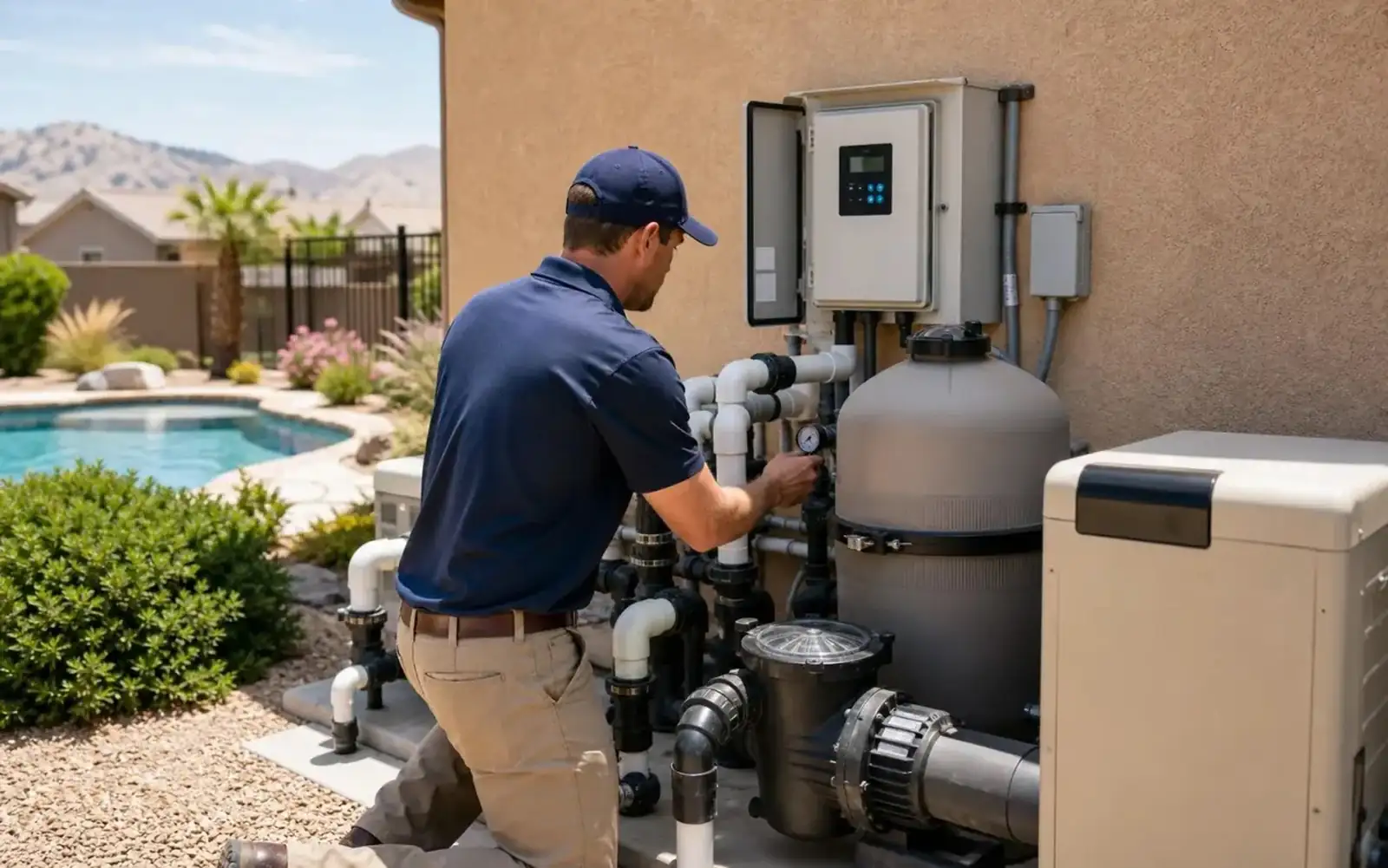

Pool Heater Diagnostic
Pool heater diagnostic
A gas heater has to complete a sequence before it makes any heat at all. Almost every heater complaint is really a question about which step it stops on.
$120 diagnostic, credited toward your repair · set pricing on many common repairs and installations
What we handle
Gas heaters that won't fire, that light and then shut down, that show an error code, or that run happily without the water ever getting warm. The visit is a diagnostic: it establishes what has failed and what putting it right involves, and anything beyond that is quoted afterwards.
Those four symptoms are not variations of one problem — they point at different parts of the sequence, and telling them apart is most of the diagnosis:
- Never lights. The heater is failing to complete ignition. Gas supply, igniter, pressure switch, or one of the safety switches that deliberately stops the sequence.
- Lights, then quits. Ignition worked, so gas and spark are fine. Something shuts it down afterwards — usually water flow, a high-limit switch, or exhaust.
- Shows a code. The board is naming a subsystem. Useful, but a code names where to look, not what to replace.
- Runs but doesn't heat. The burner is making heat. The water is not collecting it, which points at flow or valve position more often than at the heater.
What a heater is actually trying to do
Before a gas heater produces any heat it checks that water is moving through it, that the gas valve can open, that the igniter fired, that combustion air is going where it should, and that nothing has overheated. Every one of those checks can stop the sequence, and when it stops the heater simply does nothing — which from the deck looks identical regardless of cause.
This is why "the heater is broken" is not yet a diagnosis, and why guessing at parts is expensive here specifically. A pressure switch and a gas valve produce the same silence.
Repair or replace
The honest split is between the parts that wear and the part that corrodes.
Igniters, sensors, pressure switches and control boards are the components that fail on a schedule, they are replaceable, and replacing one on an otherwise sound heater is worth doing.
The heat exchanger is the other case. When it corrodes through, the repair approaches the cost of the unit, and on a heater that has already been in service a long time the rest of it is on a similar timeline. We would rather tell you that than sell you a repair that buys a season.
What drives that corrosion is water chemistry more than age. A heater run on water that sits acidic does not last, whatever it cost.
Equipment we work on
Gas heaters from the manufacturers common on Arizona pads — Pentair, Jandy and Hayward — plus older units from the same families. Natural gas and propane.
Parts availability differs by brand and by model age, and on discontinued units it sometimes decides the repair-or-replace question on its own.
What you can safely check
- Is anything else running? A heater will not fire without flow. If the pump isn't running or the filter is loaded, fix that first — the heater is behaving correctly.
- Valve positions. If someone changed a valve for spa or cleaner use, water may not be routed through the heater at all.
- The gas supply to the house. If other gas appliances are also out, the problem isn't the heater.
- The displayed code, written down exactly. Photograph it. It survives better than a description.
- The thermostat setpoint, which is a genuinely common cause and worth ruling out before a call.
When to stop
If you smell gas, stop reading and leave the area, then call your gas utility. Not us first — them. Once they have made it safe, we can look at why the heater got there.
Otherwise, stop at the panel. Opening a heater means working around gas, high voltage and hot surfaces at once, and the safety switches inside it exist because those three together are unforgiving. Bypassing one to see if the heater will run is the single most dangerous thing a homeowner can do on a pad.
What a visit looks like
We run the heater and watch the ignition sequence rather than starting from the symptom you describe, because the sequence shows where it stops. That means checking flow and valve routing first, then gas supply and ignition, then the safety switches in the order the heater consults them.
If it is a part, we say which part and why we think so. If it is the heat exchanger, we say that too, and what the rest of the unit looks like, so the decision is yours with the information in front of you rather than after the fact.
Why homeowners call us
You approve the price first
Whether we are diagnosing a fault or doing a job you already know you need, you hear the price before any work starts. Nothing is replaced until you have approved it.
Pool equipment is all we work on
Pumps, motors, filters, salt systems, automation and the plumbing at the pad. The technician who diagnoses it is the one who fixes it.
Upfront pricing
Not sure what's wrong? A $120 diagnostic finds it, and the $120 is credited toward your repair if you go ahead. Many common repairs and installations have a set price instead.
Questions we get asked
My heater worked last season and won't start now.
That is the most common way heaters fail — they sit unused through summer and don't come back. It is usually something in the ignition sequence rather than the heat exchanger, which is the expensive part. Sitting idle is also why a tune-up before you need heat is worth more than a call after.
Is a pool heater worth repairing, or should I replace it?
The diagnostic visit tells you which of those you are facing, which is the part most people are actually asking about. A fault in the ignition sequence and a corroded heat exchanger sit at opposite ends of the cost range, and the visit establishes which one you have before you decide anything. Parts and repair work are quoted once that is known.
How long should a pool heater last?
There is no single number, and anyone who gives you one is guessing. What actually determines it here is water chemistry and how often it runs — a heater fed unbalanced water corrodes from the inside regardless of brand.
What does the diagnostic tell me?
Which part of the heater's sequence it stops on and why, what putting it right involves, and whether the unit is worth putting right. Parts and repair work are quoted afterwards, and the $120 is credited toward the repair if you go ahead.
Tell us what it’s doing.
A few questions is usually enough to tell a five-minute fix from a real repair.