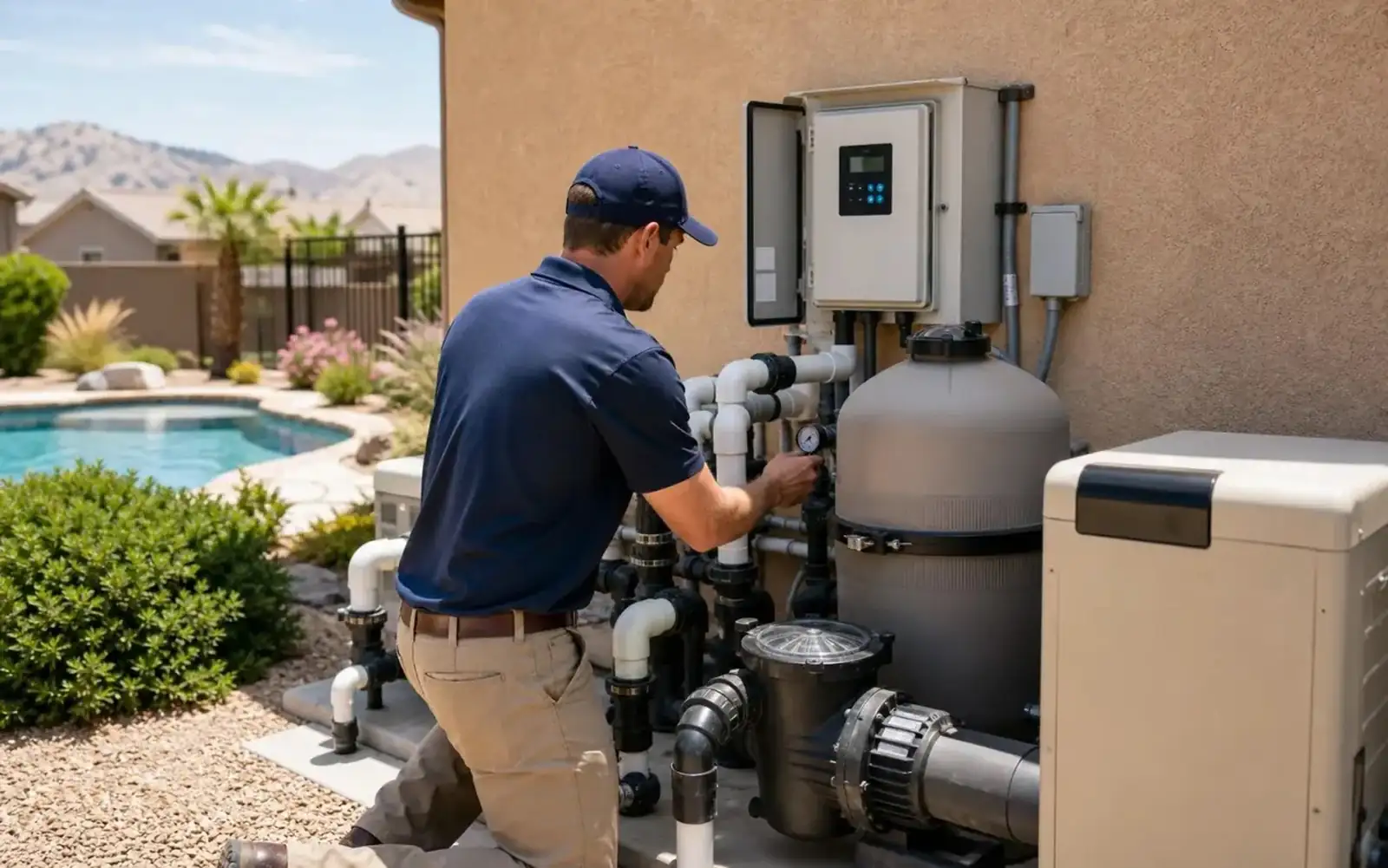
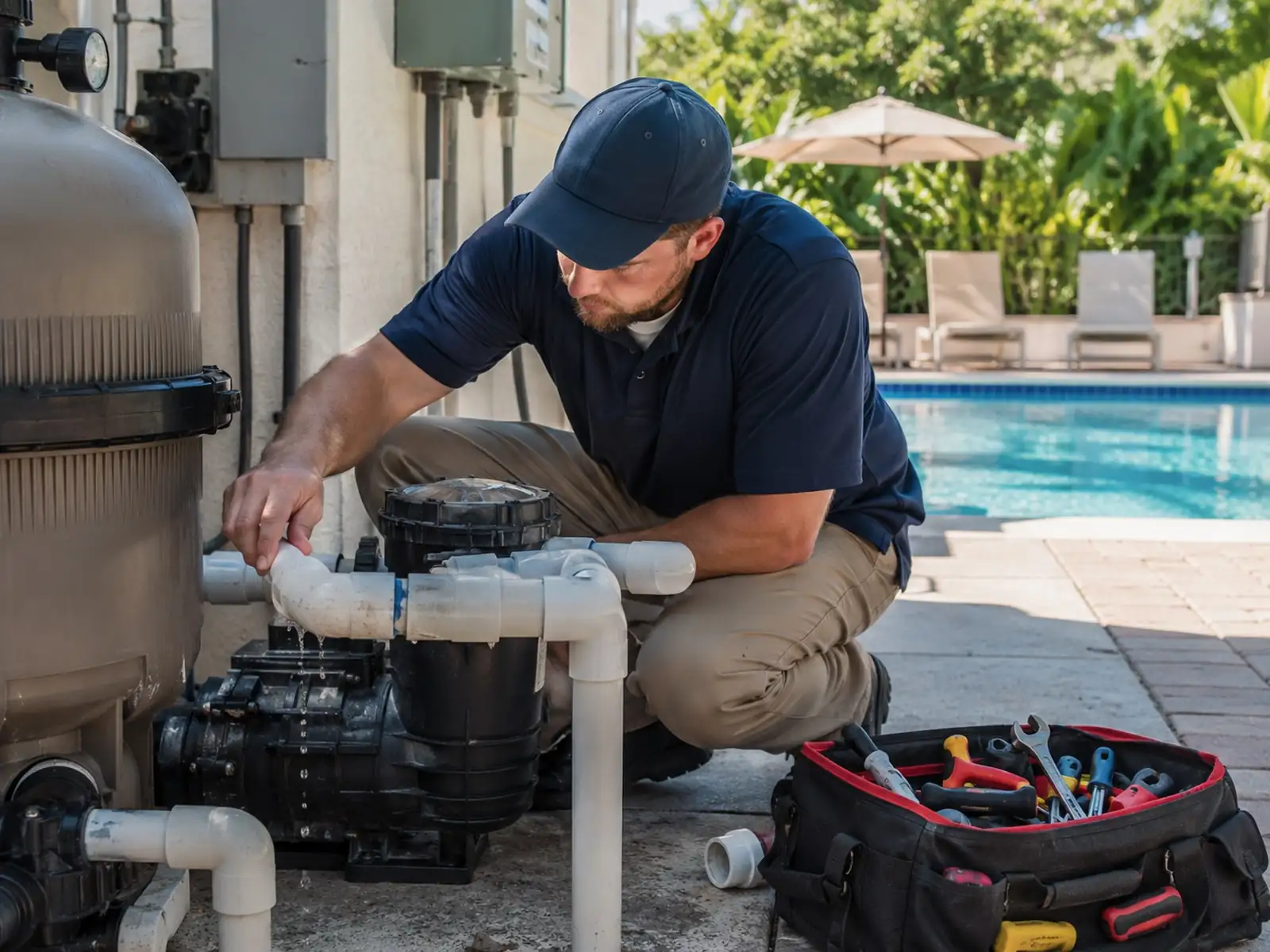

Troubleshooting
Pool pump humming but not starting
A hum means power is arriving and the motor is not turning. That is a small set of causes — and one of them gets worse every minute the pump keeps humming.
$120 diagnostic, credited toward your repair · set pricing on many common repairs and installations
Safe to check yourself
- Switch the pump off at the breaker — a humming motor is drawing current and heating up. Don't keep restarting it.
- Check whether the motor smells burnt, is smoking or is obviously hot, without touching it; if so, leave it off.
- Note the brand and model, single-speed or variable-speed, any fault code on the display, and whether the pump had been sitting unused.
- With the power off, valves closed and pressure released at the filter air relief valve, empty the strainer basket and look for debris at the pump inlet. Leave the lid on if the pot is hot.
- Refill the pot, lock the lid by hand, reopen the valves, open the filter air relief valve and restart once while standing clear.
Switch it off first
Before reading any further: turn the pump off at the breaker.
A motor that is humming is drawing current and converting it to heat instead of rotation. Left running, it will cook its own windings. The difference between a pump that gets switched off promptly and one that hums for an afternoon is frequently the difference between a repair and a replacement.
Don't keep switching it on and off to see whether it catches. Hayward's manual asks you to wait at least five seconds before restarting a pump, because restarting too soon can spin the motor backwards and damage the pump (Hayward Super Pump 700 manual, p. 7). A humming motor gets nothing from repeated attempts except more heat.
What a hum actually tells you
It splits the problem cleanly in half. Power is arriving — so everything upstream is fine. The motor is not rotating — so the fault is at the motor or at the thing the motor is trying to turn.
That leaves three realistic causes:
A jammed impeller. Something has found its way in and physically stopped it. This is the cause Hayward's troubleshooting table lists for "motor hums, but does not start", and its answer is to have a qualified repair professional open the pump and remove the debris (Hayward Super Pump 700 manual, p. 11; Hayward VS Omni manual, p. 11). Once the debris is out, this can be the lightest repair of the three.
A seized motor. Bearings that have failed completely, or a motor that has been sitting long enough to bind. Pentair's chart lists a locked motor as a reason a pump fails to start, with disassembly and freeing the shaft as the fix (Pentair SuperFlo VS guide, p. 18).
The start circuit. A single-speed induction motor needs help getting moving, and the motors on these pumps carry a capacitor for it — Hayward lists one as a replacement part, and Pentair's disassembly steps for some motors mention moving it aside (Hayward Super Pump 700 manual, p. 10; Pentair SuperFlo guide, p. 5). If that kick is missing, the motor sits and hums.
They present identically from the deck and differ substantially in cost, which is why guessing is a bad strategy here.
Safe checks at the pad, in order
These are the checks a homeowner can make without opening the motor or working near live wiring. Do them in this order and stop wherever the answer becomes clear.
- Power off at the breaker. Not just the timer or the automation button — the breaker that feeds the pump. Everything below assumes it is off.
- Look and smell; don't grab. If the motor smells burnt, is smoking, or is obviously giving off heat, stop here and leave it off (see below). Pentair tells technicians to let a motor cool for 20 minutes before handling it (Pentair IntelliFlo VS+SVRS guide, p. 26).
- Write down what you can see. The brand and model on the motor label, whether it is single-speed or variable-speed (a variable-speed pump has a keypad or display on the motor), any fault code on that display, and whether the pump had been sitting unused. A photo of the label does the job.
- Check the strainer basket for debris — carefully. Close the suction and return valves if your pad has them, release pressure at the filter's air relief valve, then open the lid (Hayward Super Pump 700 manual, p. 7). Empty the basket and look into the pump inlet. If the pot is hot to the touch, leave the lid on: Pentair warns that a pump that has run without water can build vapor pressure and contain scalding water (Pentair SuperFlo guide, p. 4–5). Jandy's own blocked-impeller steps start the same way — power off, lid and basket out, remove any debris you can see (Jandy VS pump manual, p. 22).
- Close it up properly. Clean O-ring seated, lid locked by hand, pot filled with water, valves reopened. Never run the pump with an empty pot.
- One restart, standing clear. Open the filter's air relief valve, stand back from the filter, restore the breaker and start the pump once. If it runs, close the air relief valve when a steady stream of water comes out (Hayward Super Pump 700 manual, p. 7). If it hums again, switch it off at the breaker and leave it off.
If a basket full of leaves was the whole story, step 6 is where you find out. If it still hums, the blockage is inside the impeller or the fault is in the motor, and both are behind covers that stay closed.
Why "it sat unused" matters
We ask because it shifts the odds. A pump that ran fine yesterday and hums today points more toward the start circuit or fresh debris. A pump that has been off for weeks or months points more toward binding. Neither is conclusive — it is a prior, not a diagnosis.
Heat and burning smells
If the motor is too hot to touch briefly, or smells burnt, or is producing smoke, this stops being a diagnostic question. Shut it off at the breaker and leave it off. A hot motor is a fire risk and continuing to test it destroys parts that are currently fine.
Hayward motors carry an automatic thermal overload protector: it shuts the motor off before heat damage builds, restarts it once it cools, and keeps cycling until the cause is corrected (Hayward Super Pump 700 manual, p. 11). A pump that hums, clicks off, and hums again later is that protector doing its job — not the problem fixing itself.
Pentair's motor-care guidance is to shade the motor from the sun and keep any enclosure well ventilated (Pentair SuperFlo guide, p. 5) — worth checking on an East Valley pad in summer.
Variable-speed pumps
A variable-speed pump has an electronic drive on the motor, and its manual lists the alarms and fault codes that drive can show. Note any code on the display before you do anything else.
- Jandy's chart says debris between the impeller and diffuser can stop the shaft and put the motor into an error, and that a professional should check whether the shaft is seized with all power off (Jandy VS pump manual, p. 21).
- To clear an error, Jandy says to switch off the breaker and wait at least five minutes before restoring power, so the capacitors drain fully (Jandy VS pump manual, p. 21).
- Pentair's IntelliFlo VS+SVRS reports Over Current when the drive is overloaded or the motor has an electrical problem, and restarts on its own 20 seconds after the condition clears (Pentair IntelliFlo VS+SVRS guide, p. 27).
Never open the drive. Pentair warns that its drive's capacitor bank holds a 230 VAC charge even with no power to the unit, and that the screws on the intermediate drive cover must never be removed (Pentair IntelliFlo VS+SVRS guide, p. iii, p. 25). Our variable-speed pump repair page covers what a drive or motor diagnosis involves.
Where homeowner work stops
- Turning the motor shaft by hand to see whether it is seized. The manuals describe it, but it means reaching the shaft through the motor's fan cover or taking the pump apart (Hayward Super Pump 700 manual, p. 9, p. 11).
- Removing the motor end cover, or testing or replacing a capacitor. Capacitors hold a charge after the power is off.
- Opening the pump to clear a jammed impeller.
- Checking supply voltage at the motor. Jandy asks for a professional to confirm it is within 10% of the motor's rating plate (Jandy VS pump manual, p. 21).
What a technician does next
Confirms the motor is not mechanically bound before assuming it is electrical, then tests the start components with the power isolated and the capacitor safely discharged. Order matters: testing electrical components on a mechanically seized motor produces a confident wrong answer.
Get it looked at
Not sure what's wrong? A $120 diagnostic finds what has failed and what fixing it involves, and the $120 is credited toward your repair if you go ahead. If you would rather narrow it down first, the Pool Problem Finder asks the questions a technician would and points you to the next step. Our pool pump repair page covers single-speed motors, seals and impellers, and pool equipment diagnostics explains how the visit runs.
Related
Pool pump repair · Variable-speed pump repair · Pool pump not turning on · Pool pump keeps shutting off · Pool pump tripping the breaker · Pool pump making a loud noise
Sources
Manufacturer documents opened and read for this page. Page numbers are the printed numbers in each document.
- Hayward Super Pump 700 Series Owner's Manual, IS26001 Rev-B — start-up and priming p. 7; shaft access p. 9; parts list p. 10; troubleshooting p. 11.
- Hayward VS Omni Pump Owner's Manual, 092708 Rev B — troubleshooting p. 11.
- Pentair SuperFlo High Performance Pump Installation and User's Guide, P/N 350096 Rev. P (12/19/23) — strainer pot warnings p. 4–5; motor care and disassembly p. 5.
- Pentair SuperFlo VST, SuperFlo VS and SuperMax VS Installation and User's Guide, P/N 356292 Rev. A (7/10/20) — troubleshooting p. 18.
- Pentair IntelliFlo VS+SVRS and IntelliPro VS+SVRS Installation and User's Guide, P/N 356916 Rev. D (11/6/23) — capacitor warning p. iii; drive cover warning p. 25; motor cooling p. 26; alerts p. 27.
- Jandy Variable-Speed Pumps Installation & Operation Manual, H0707400 Rev F — troubleshooting p. 21; blocked impeller p. 22.
Leave this to a technician
- Turning the motor shaft by hand to check for seizure — it means reaching the shaft through the fan cover or taking the pump apart.
- Removing the motor end cover to reach the start components.
- Testing or replacing a start capacitor — capacitors hold a charge after power is off.
- Opening a variable-speed drive — Pentair warns its capacitor bank holds a 230 VAC charge with no power to the unit.
- Checking supply voltage at the motor.
- Freeing a seized motor shaft or a blocked impeller.
- Deciding between a motor repair and a replacement.
Questions we get asked
Should I leave it humming while I wait for someone?
No. A motor drawing current without turning heats up fast, and heat is what turns a modest repair into a motor replacement. Switch it off at the breaker and leave it off.
Is this always the capacitor?
No. It is the common assumption, but Hayward's own troubleshooting table for this exact symptom points first at an impeller jammed with debris. A seized motor and a failed start circuit sound the same from the deck, and they are different repairs.
Can I test the capacitor myself?
We'd rather you didn't. Capacitors store a charge after the power is off, and Pentair's manuals warn that the capacitor bank in their variable-speed drives holds a 230 VAC charge even with no power to the unit.
My variable-speed pump shows a fault and won't run. Is that the same thing?
Close to it. Jandy's manual describes debris between the impeller and diffuser stopping the shaft and putting the motor into an error. Write the code down, switch the pump off at the breaker, and use the Problem Finder or book a diagnostic.
Tell us what it’s doing.
A few questions is usually enough to tell a five-minute fix from a real repair.