
Troubleshooting
Pool pump leaking
With pump leaks, location is the diagnosis. Where the water appears narrows it to one or two causes almost immediately.
$120 diagnostic, credited toward your repair · set pricing on many common repairs and installations
Safe to check yourself
- Check whether water is reaching the motor or any electrical connection — if it is, stop and shut it off.
- Dry the pad and watch where the water reappears.
- Check the pump lid o-ring for cracks, flat spots or grit.
First, the safety question
Is water running onto the motor, or into any electrical connection?
If yes, stop. Shut the equipment off at the breaker if you can reach the breaker without touching the wet equipment itself, keep people away from it, and get it looked at today. Water and line voltage on an outdoor pad is not a problem that improves with time.
Everything below assumes the answer was no.
Where the water appears
Between the motor and the pump body. The shaft seal. This is the classic pump leak and the one worth acting on quickly — not because the seal is expensive, but because that water travels into the motor bearings. A shaft seal caught early is a modest repair. Left running, it becomes a motor replacement, and you paid for the privilege of waiting.
Around the clear lid on top. Usually the o-ring underneath it: dried out, flattened, pinched on reassembly, or with grit on the sealing surface. This one is genuinely homeowner work and often costs almost nothing.
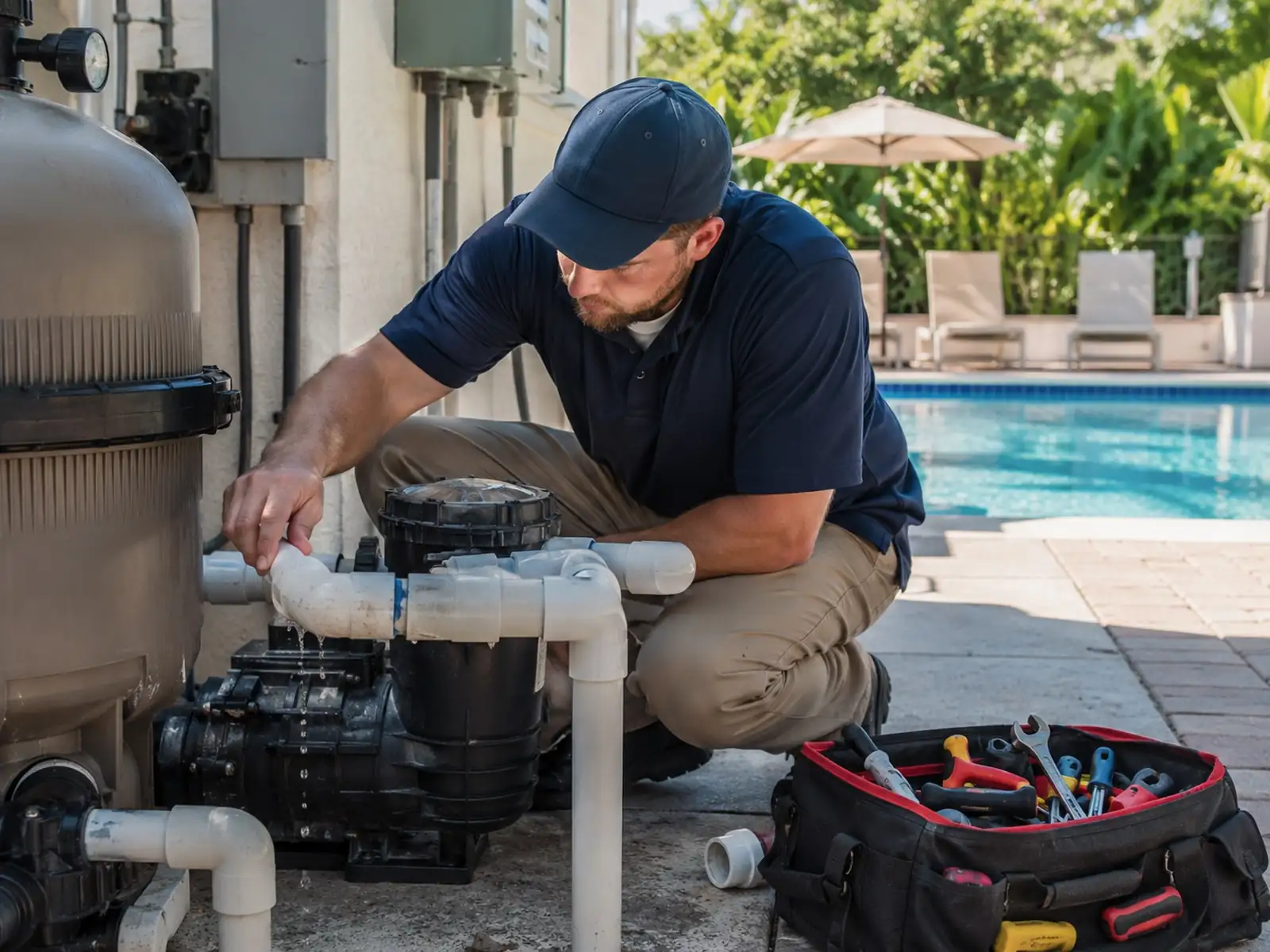
At a pipe joint, union or valve. Fittings on an equipment pad move with temperature, and the East Valley gives them a lot of range to move through. Some tighten up; some are cracked and need replacing. Restraint helps here — overtightening is how a drip becomes a break.
Somewhere on the pad, source unclear. Water travels along pipes and across a slab, so where it shows up is often not where it starts. Dry everything, run the system, and watch.
What you can do yourself
- Check the lid o-ring. Pump off, lid off, clean the o-ring and its groove, look for cracks or flat spots, reseat it properly. A thin smear of the correct lubricant helps; petroleum jelly does not — it degrades the seal.
- Dry the pad and watch. Finding where water reappears first is most of the diagnosis.
- Photograph the wet area. Genuinely useful before a visit.
Where it stops being homeowner work
Replacing a shaft seal — it means separating the motor from the pump body. Repairing or replacing glued fittings, unions and valves. And anything at all where water has already reached electrical parts.
Don't let it run
Two reasons. A shaft seal leak is actively damaging the motor while the pump runs. And a leak on the suction side lets air in as well as water out, which starves the pump — so you can end up with a flow problem stacked on top of the leak.
Related
Pool pump repair · Pool equipment repair · Pool equipment diagnostics
Leave this to a technician
- Replacing a shaft seal.
- Repairing or replacing a leaking union, valve or glued fitting.
- Any leak where water has already reached electrical parts.
Questions we get asked
Is a small drip worth worrying about?
It depends where. A weep at the lid is minor. Water between the motor and the pump body is a shaft seal, and that water gets into the motor bearings — which is how a modest repair becomes a motor replacement.
Can I just tighten the union?
Carefully, and not much. Overtightening a union is a reliable way to turn a drip into a crack, and then it's a part replacement rather than an adjustment.
Water is dripping onto the motor. Is that dangerous?
Yes. Water reaching a motor or an electrical connection is a shock hazard. Shut the equipment off at the breaker if you can do that without touching the wet equipment, and don't handle it.
Tell us what it’s doing.
A few questions is usually enough to tell a five-minute fix from a real repair.