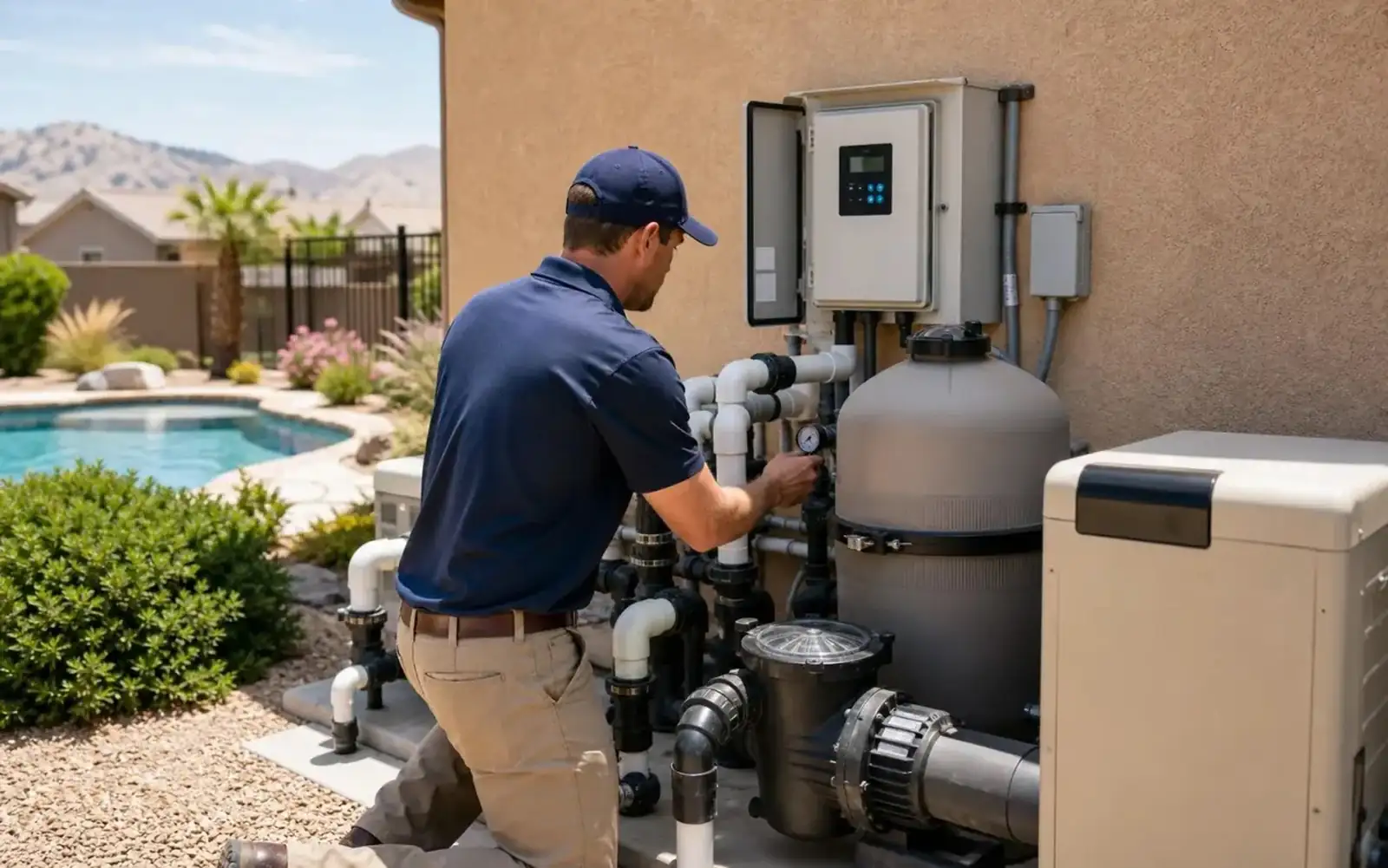
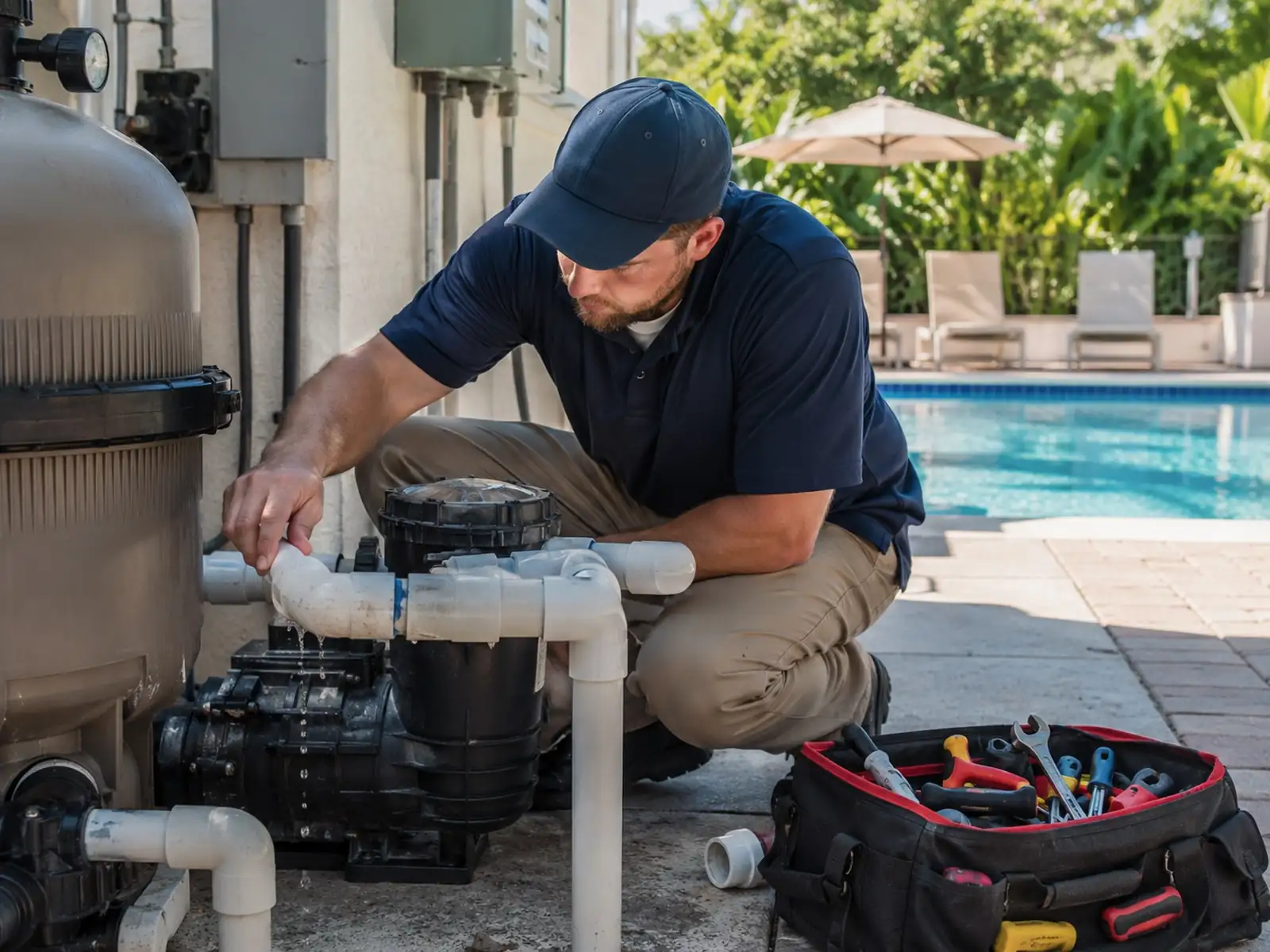

Troubleshooting
Pool pump losing prime
A pump that will not hold prime is not a pump problem so much as an air problem. The pump is doing what it can with what is reaching it.
$120 diagnostic, credited toward your repair · set pricing on many common repairs and installations
Safe to check yourself
- Look at the pump basket with the pump running — water, air bubbles, or empty each mean something different.
- Check the pump lid o-ring for cracks, flattening or grit sitting on the sealing face.
- Note whether it loses prime overnight, or within minutes of shutting off.
- Check the water level is above the middle of the skimmer opening.
What losing prime actually is
The pump has to be full of water to move water. It cannot pull air out of a pipe and then start pumping — it has no way to get hold of it. So when the pot is empty, nothing happens, no matter how healthy the motor is.
That means the question is never really "why won't it prime." It is where is the air coming in, and the answer is almost always on the suction side: anywhere between the pool and the impeller. Air cannot get in downstream of the pump, because everything past the impeller is under pressure and pushing outward.
The observation that splits the diagnosis
Watch the pump basket with the pump running.
Full of water, no bubbles. The pump is primed. Whatever is wrong is happening when it shuts off, not while it runs — a leak that lets the pipe drain back once suction stops.
Water with a steady stream of bubbles. Air is being drawn in continuously while the pump runs. There is an opening on the suction side that stays open.
Empty, or mostly air. It has lost prime and will not recover on its own.
That single observation does more to narrow this down than anything else you can do without tools, which is why the diagnostic asks for it first.
The usual causes, roughly in order
- Water level too low. Below the middle of the skimmer opening, the skimmer starts pulling air. Free to check, free to fix, and genuinely common in an Arizona summer.
- The pump lid o-ring. Cracked, flattened, dried out, or with grit on the sealing face. This is the single most common real fault on this symptom and it is an inexpensive part.
- A loose or cracked fitting on the suction side. Often at a union, sometimes at a valve.
- A failing shaft seal. Draws air while running and lets water into places it should not go. This one is a genuine repair, not a part swap.
- A leak in the underground suction line. Uncommon, expensive to find, and worth ruling everything else out first.
- A worn impeller or diffuser. The pump loses its ability to generate suction in the first place.
What you can check safely
The water level. The lid o-ring — with the pump off, and with the understanding that a lid on a running pump is under pressure and should never be opened. Whether the basket is full, bubbling or empty. And whether it loses prime overnight or within minutes of shutting off.
Those four observations cost nothing and cover most of what a technician would ask on the phone.
Where it stops being homeowner work
Finding where air enters a suction line that looks fine from outside. Pressure-testing lines. Anything involving the shaft seal, the diffuser or the impeller — those require opening the pump, and reassembling it wrong turns a small leak into a flooded motor.
The thing genuinely worth avoiding: priming it by hand every morning and carrying on. It runs, so it feels solved. It is not solved, and each dry start is doing damage that the eventual repair bill will reflect.
Related
Pool pump repair · Pool pump running but no water flow · Pool pump making a loud noise
Leave this to a technician
- Pressure-testing the suction line to find where air is entering.
- Diagnosing a failed shaft seal that draws air while running.
- Inspecting or replacing the pump's diffuser and impeller.
- Repairing an underground suction-side leak.
Questions we get asked
I refill the pot every morning and it runs fine all day. Is that a workaround?
It is, and it is a costly one. Every dry start runs the shaft seal without water to cool it, and that seal is what keeps water out of the motor. A pump primed by hand every morning is usually on its way to a much larger repair.
Is it worse in summer here?
Evaporation drops the water level faster in an Arizona summer, and a low level in the skimmer lets air in on its own. Check the level before assuming anything is broken — it is the one cause you can rule out in ten seconds.
The basket has bubbles in it. Does that mean the same thing?
It is closely related but not identical. Bubbles while running mean air is being drawn in continuously somewhere on the suction side. An empty pot after sitting overnight means air is getting in when the pump stops. The two often share a cause, and the finder separates them.
Tell us what it’s doing.
A few questions is usually enough to tell a five-minute fix from a real repair.