
Pool Plumbing & Equipment-Pad Leak Repair
Pool plumbing and equipment-pad leak repair
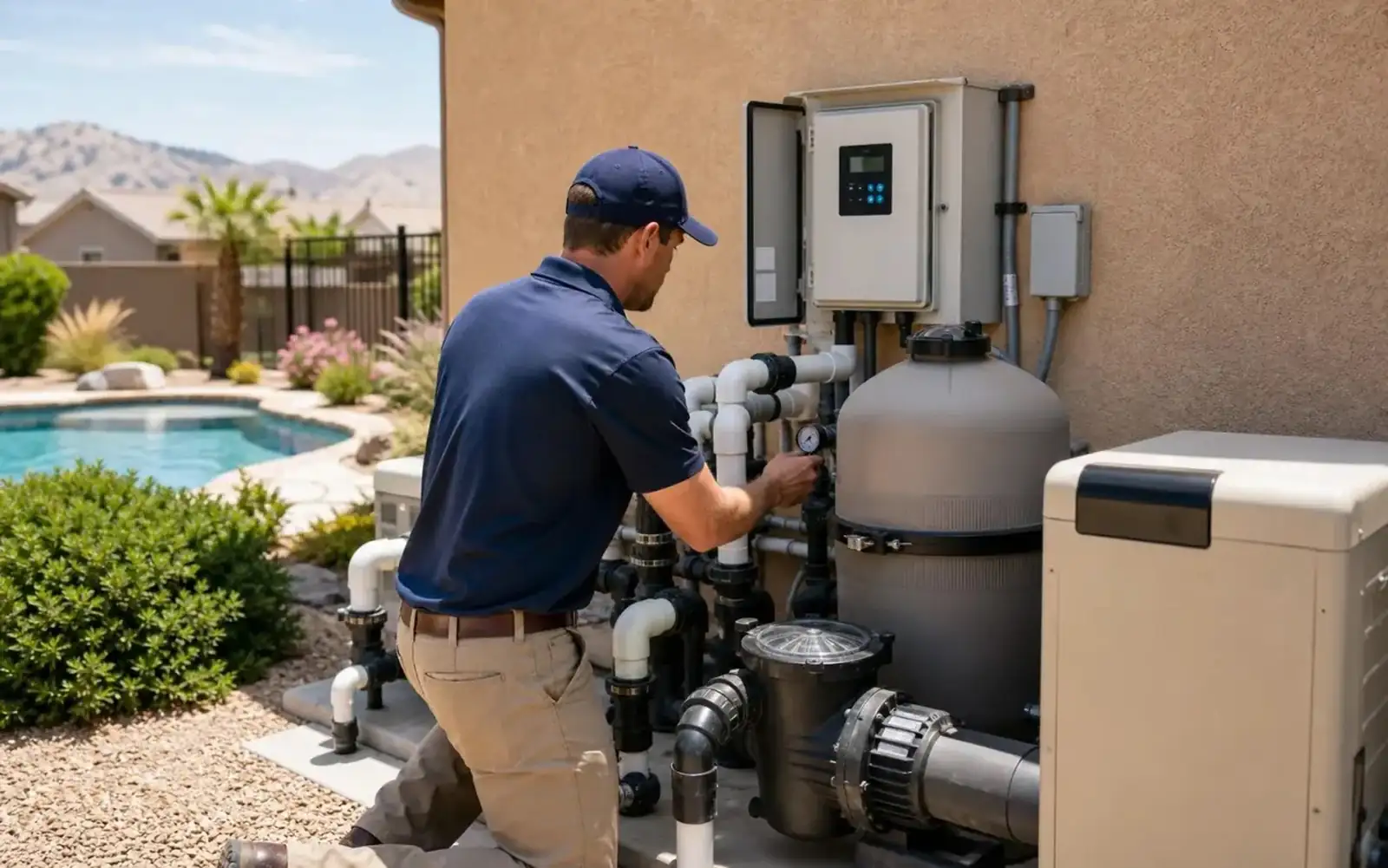
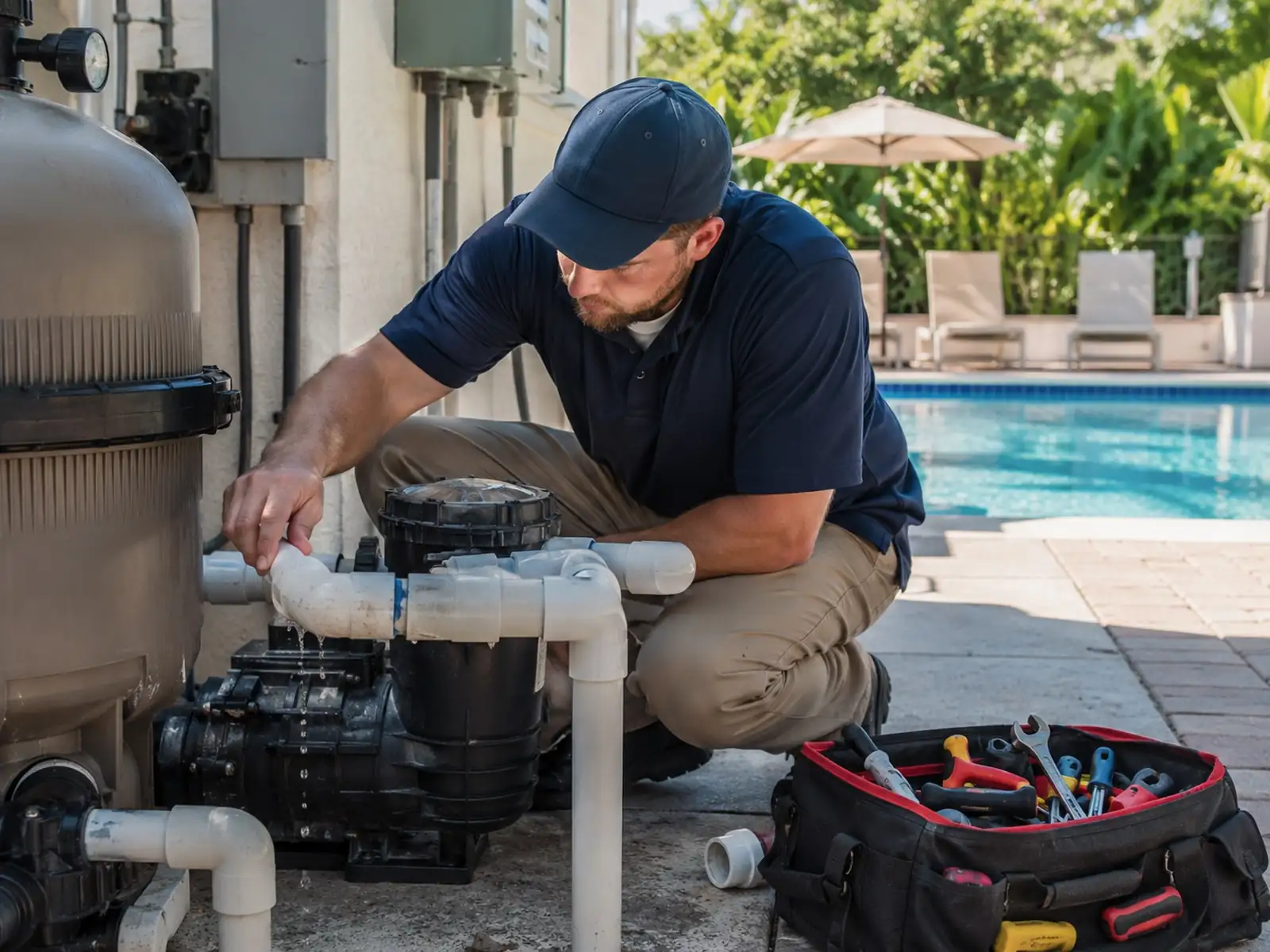
Leaks at the equipment pad and in accessible plumbing — unions, seals, housings, fittings, valve stems and water levellers. Diagnosed with the system running, because pressure side and suction side leak differently.
$120 diagnostic, credited toward your repair · set pricing on many common repairs and installations
What we cover, and what we do not
This is the clearest boundary on the site, so it goes first rather than in a footnote.
We do repair:
- Leaks at the equipment pad — unions, valves, filter bodies, pump housings and lids, threaded fittings, pressure gauges
- Pump shaft seals and mechanical seals
- Leaks in plumbing that is visible and reachable — above ground, in an equipment enclosure, or otherwise accessible without excavation
- Clearing accessible equipment-pad plumbing lines
Between them these account for most of the water a pool loses at the equipment, and all of them are visible, reachable and repairable in a visit.
If the pad turns out not to account for the loss, you will hear that in the same visit — which is itself worth knowing, because it narrows the search considerably before anyone starts looking further afield.
The useful first question
Not "where is the leak" but "is there one".
Arizona evaporation takes a genuinely surprising amount of water off a pool. Before anything else is worth doing, it is worth establishing whether the loss is beyond what evaporation explains — otherwise everyone spends money chasing a leak that isn't there.
After that, the split is simple and it decides who you need:
- Water where it shouldn't be at the equipment — that is us.
- Water disappearing with nothing visible anywhere — that may be us, and we can rule the equipment side out quickly, but it may be a leak-detection specialist.
Problems we see
- Dripping or spraying at a union or fitting. Usually a seal, an O-ring, or a fitting that has been overtightened at some point in its life.
- Water under the pump. Where it comes from matters: the lid seal, the shaft seal, and the housing are three different repairs with three different costs.
- A filter body weeping at the band or the drain plug. Common, usually a seal.
- A valve leaking around the stem or the body. Sometimes a rebuild, sometimes a replacement.
- A wet patch on the pad with no obvious source. Worth photographing before you call; the pattern when the pump is off versus running tells us a lot.
Repair or replace
Seals, O-rings and gaskets are consumables. Replacing them is ordinary maintenance and always worth doing.
The judgement call is with plumbing that has been repaired repeatedly. PVC that has been cut and coupled several times in the same run gets fragile and crowded, and there is a point where replacing a section is more honest than adding another joint to it. We will say when we think you have reached it.
A pump housing cracked through is generally a replacement rather than a repair, and we will tell you that rather than sell you a patch.
What you can safely check
- Turn the pump off and watch. A leak that stops when the pump stops is on the pressure side; one that continues is often on the suction side or below water level. That single observation narrows it considerably.
- Mark the water line and check it again in 24 hours with the pump running normally, then repeat with the pump off. Comparing the two is the closest thing to a home test.
- Photograph the wet area — dry it, run the pump, and watch where it reappears first.
- Check the backwash or waste line if the filter has one. A valve passing water to waste looks exactly like a leak and is not one.
When to stop
Stop when water and electricity are meeting. Water running onto a motor, a junction box, a timer or a breaker panel is not a plumbing problem any more — shut that circuit off at the breaker and call.
Also stop before tightening anything hard. A weeping union is a seal; a union cracked by someone tightening it is a part. The temptation is real and it usually costs more than the leak did.
What a visit looks like
We run the system and look, which sounds obvious and is most of it. Pressure side and suction side behave differently, so the pump goes on and off deliberately rather than staying in one state.
If the leak is at the pad or in reachable plumbing, we will tell you what it is and what fixing it involves. If nothing at the pad accounts for the loss, you will hear that in the same visit, along with what to ask a leak-detection specialist for.
Set prices
- Blowing out clogged lines$180
You hear the full price before any work starts. Not sure what’s wrong? That’s the $120 diagnostic, credited toward your repair if you go ahead.
Why homeowners call us
You approve the price first
Whether we are diagnosing a fault or doing a job you already know you need, you hear the price before any work starts. Nothing is replaced until you have approved it.
Pool equipment is all we work on
Pumps, motors, filters, salt systems, automation and the plumbing at the pad. The technician who diagnoses it is the one who fixes it.
Upfront pricing
Not sure what's wrong? A $120 diagnostic finds it, and the $120 is credited toward your repair if you go ahead. Many common repairs and installations have a set price instead.
Questions we get asked
My pool is losing water but I can't see a leak anywhere. Can you find it?
We can rule the equipment side in or out, which is worth doing first because it is quick and it is a common cause. If the pad accounts for the loss you have your answer in one visit. If it does not, we will say so clearly and point you at a leak-detection specialist, who has the listening equipment that job needs.
How much water loss is normal?
More than most people expect, in this climate. Evaporation alone takes a real amount off a pool through an Arizona summer, and wind and heat make it worse. Establishing whether there is a leak at all is genuinely the first step, not a stalling tactic.
Water is dripping from under the pump. Is that urgent?
It depends where. A drip from the shaft seal area is a repair that should be scheduled rather than rushed. Water running onto electrical connections or into the motor is different — shut the pump off at the breaker and call.
Can you repair a leak in the pipe between the pool and the equipment?
If it is exposed and reachable, yes — that is exactly this work. A buried line needs locating first, which is a leak-detection specialist's equipment rather than ours.
Tell us what it’s doing.
A few questions is usually enough to tell a five-minute fix from a real repair.