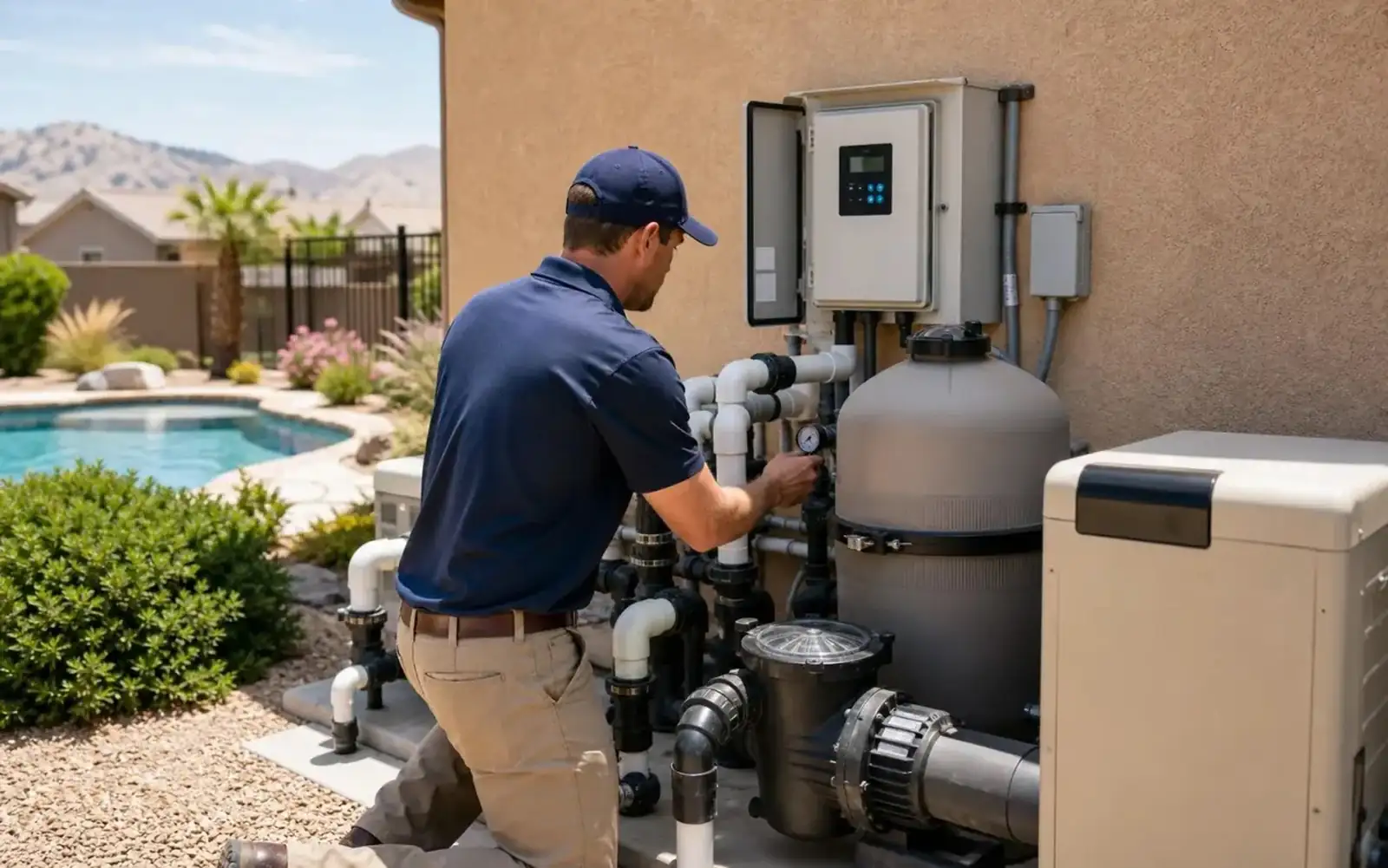
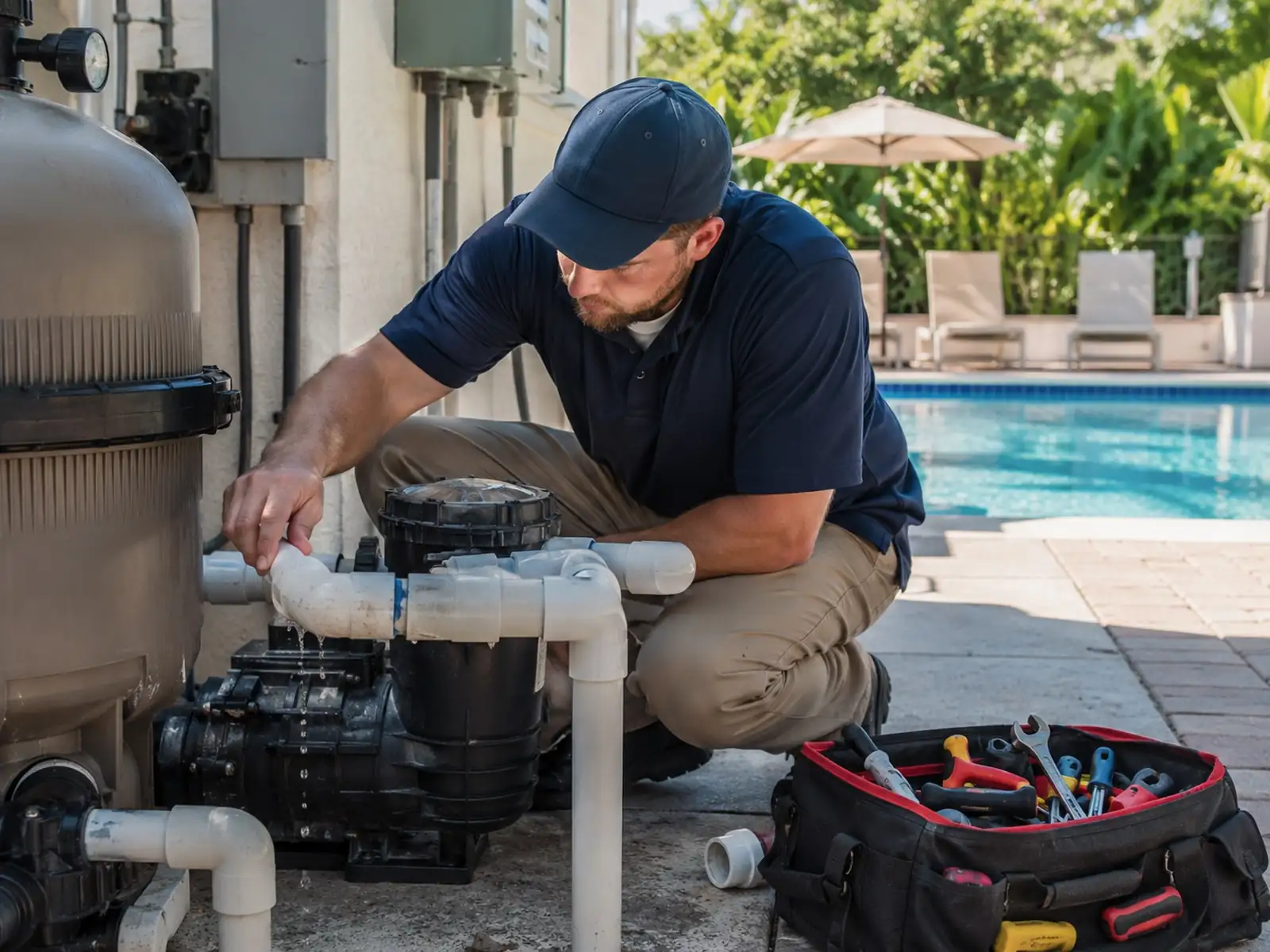

Pool Pump Repair & Installation
Pool pump repair and installation
The pump is the one piece of equipment everything else depends on. When it stops, the pool stops. Most pump calls come down to a small number of causes, and telling them apart is most of the job.
$120 diagnostic, credited toward your repair · set pricing on many common repairs and installations
What usually goes wrong
Pumps fail in a handful of recognisable ways, and each points somewhere different:
| What it's doing | Where the fault usually is |
|---|---|
| Completely dead | Power: breaker, timer, switch, wiring, or the motor |
| Humming, won't start | Start circuit, a seized motor, or a blocked impeller |
| Runs, no water moves | Suction side: baskets, air leak, valve, impeller — or the filter |
| Starts then stops | Thermal overload, or an electrical fault |
| Screeching or grinding | Motor bearings |
| Gravel sound | Cavitation — starved for water |
| Leaking under the motor | Shaft seal |
That table is why we ask what the pump is doing rather than what you think is broken. The symptom narrows the field faster than a guess at the part.
How the diagnosis actually goes
Roughly in this order, because each step rules out the cheap causes before the expensive ones:
- Confirm it is being told to run. Breaker, timer, automation schedule. A surprising share of dead pump calls end here, and it costs nothing to check.
- Confirm power reaches the motor. Voltage at the right points under load. This is the step that separates a control problem from a motor problem, and it needs a meter.
- Confirm water reaches the pump. Baskets, water level, valve positions, air in the pump basket.
- Confirm water leaves the pump. Filter pressure against its normal clean reading, return flow.
- Then open the pump. Impeller, seal, volute, diffuser.
Skipping to step five is how people end up with a new pump and the same problem, because the restriction was in a valve.
What you can check before we come out
Some of these solve it outright:
- Whether the breaker is tripped. Reset it once — if it trips again, leave it off.
- Whether the timer or automation is actually calling for the pump to run.
- Whether the pump and skimmer baskets are packed.
- Whether the water level is above the skimmer mouth.
None of those require opening anything electrical, and any of them can be the whole problem.
Where we stop and you should too
Voltage testing at the motor, opening a panel cover, testing or replacing a start capacitor — a capacitor holds a charge after the power is off — and anything at all after a breaker has tripped a second time. That last one is not caution for its own sake: a breaker tripping repeatedly is detecting a fault, and resetting it repeatedly is a fire risk.
Repair or replace a pool pump
The case for repair: seals, capacitors, impellers and lids are inexpensive relative to a pump, and a sound motor is worth keeping.
The case for replacement: a motor with failing bearings, a cracked housing, or a single-speed pump on a pool where a variable-speed unit would meaningfully cut the running cost. In Arizona, where pumps run long hours through a long season, that last argument is stronger than it is in most of the country.
We will tell you which case yours is in. See variable-speed pump repair if yours already is one.
Installing a pump, or just the motor
Two different jobs, and which one you need is worth establishing before anything is ordered.
A motor replacement keeps the existing wet end — the housing, the basket, the plumbing connections — and swaps the motor and seal. It is the right answer when the motor has failed and the rest of the pump is sound, which is common.
A full pump replacement is the answer when the housing is cracked, the wet end is worn, or the pump is undersized or oversized for the plumbing it sits on. It is also the moment to consider a variable-speed pump, because doing it later means paying for the installation twice.
Sizing matters more than brand here. A pump moving water faster than the plumbing was built for is noisy, inefficient and hard on everything downstream of it — and it is a genuinely common thing to find on a pad where somebody replaced like-for-like without checking what "like" was.
Start with what it's doing
Set prices
- Pump installation$225 labor
- Blowing out clogged lines$180
Labor prices don’t include the pump, filter or parts, which are quoted with the job. You hear the full price before any work starts. Not sure what’s wrong? That’s the $120 diagnostic, credited toward your repair if you go ahead.
Why homeowners call us
You approve the price first
Whether we are diagnosing a fault or doing a job you already know you need, you hear the price before any work starts. Nothing is replaced until you have approved it.
Pool equipment is all we work on
Pumps, motors, filters, salt systems, automation and the plumbing at the pad. The technician who diagnoses it is the one who fixes it.
Upfront pricing
Not sure what's wrong? A $120 diagnostic finds it, and the $120 is credited toward your repair if you go ahead. Many common repairs and installations have a set price instead.
Questions we get asked
Can a pump be repaired, or does it always need replacing?
Often repaired. Seals, capacitors, impellers, lids and wiring are all serviceable. Replacement makes sense when the motor itself is at the end of its life or when the repair cost approaches a new pump that will also cut your power bill.
How long does a pump repair take?
Many are a single visit. What extends it is a part that has to be ordered, which is why a photo of the equipment up front helps so much.
My pump is loud. Is that urgent?
It depends what kind of loud. Screeching and grinding tend to get worse and can take the seal with them. A gravel sound usually points at something upstream starving the pump. Both are worth looking at rather than living with.
Tell us what it’s doing.
A few questions is usually enough to tell a five-minute fix from a real repair.