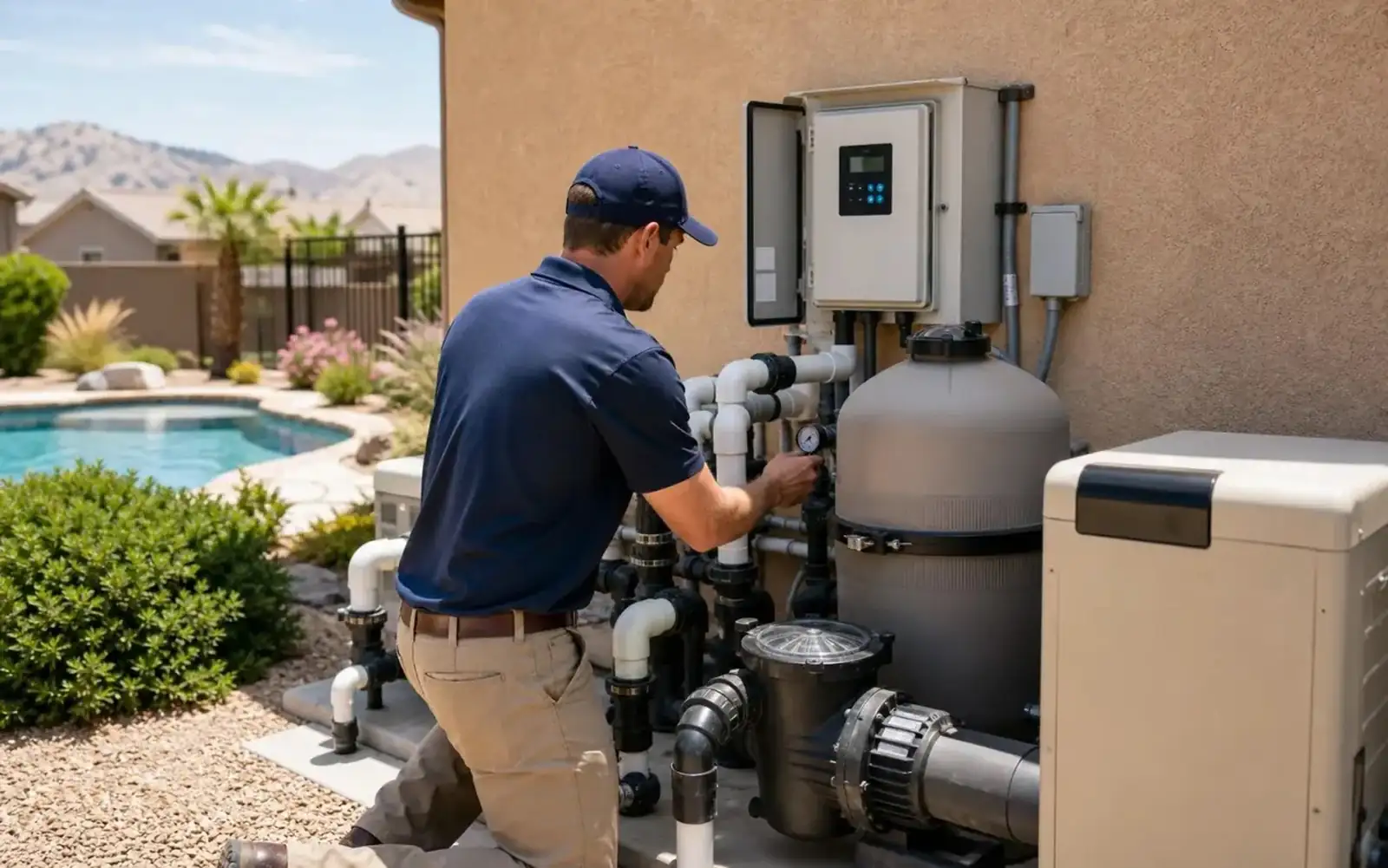

Pool equipment
A Queen Creek pool owner's guide to water, draining, disposal and local help
The local rules and services a Queen Creek pool owner actually runs into, from who supplies your fill water and how hard it is, to where the Town lets you drain or backwash, how to get rid of old pool chemicals, and who to ask before electrical work. Every fact links to the Town or utility that published it.
$120 diagnostic, credited toward your repair · set pricing on many common repairs and installations
Most of what decides how long pool equipment lasts in Queen Creek isn't on the equipment pad. It's the water that fills the pool, what you do with the water when it leaves, and the summers in between. This guide collects the local rules and services a pool owner actually runs into, with a link to the Town or utility page each one comes from, so you can check the current version yourself.
Who supplies your water, and how hard it is
Queen Creek isn't served by one water company. The Town's Water Department covers about 40 square miles of the Queen Creek area, and the Town says other companies serve other parts of it, depending on where you live. Its local water providers page has a map of the Town's service area. EPCOR is one of the other providers: under a 2022 exchange approved by the Arizona Corporation Commission, EPCOR took water service for some areas outside the Town's boundaries (Town utility exchange page). Your water bill is the quickest way to tell which you're on.
The two waters are both hard:
- Town of Queen Creek: 6 to 17 grains per gallon, from groundwater wells (Town water FAQ). The full figures are in the Town's annual water quality report.
- If you're on EPCOR's San Tan system: 15 to 18 grains per gallon (EPCOR 2025 San Tan water quality report).
Why it matters for equipment: hard water leaves scale, and summer evaporation concentrates it, because the water leaves and the minerals stay behind. Scale builds on salt cell plates and inside heaters first. A salt system that makes less chlorine every month, or reports low salt when your test says otherwise, is often scaled rather than worn out. See why a salt system says low salt when the water tests fine.
Draining and backwashing: where the water can go
The Town's pool draining policy lists two options, in this order:
- Your own property first. Drain as much of the pool as you can, backwash included, onto your own landscape. Dechlorinate it first, because some plants are sensitive: the Town's method is to let the pool sit uncovered in direct sun for a few days without adding chemicals. Don't let it run off your property.
- The curb or gutter for whatever your yard can't take. It flows to your community's storm water retention basin, so the water must be dechlorinated, the street must not generally have flooding problems, the hose must reach the curb so it doesn't erode the soil, and you mustn't flood a neighbor's property.
The Town's water FAQ adds a third route for draining: your home's sewer clean-out. Where it is depends on the age of the home, and the Town suggests a plumber or the home builder if you can't find it. It's only for homes on the public sewer. The Town warns that septic tanks aren't designed for these flows and that draining a pool into one can mean expensive repairs. The same FAQ says no permit is required to drain a pool, and reminds you that pool water carries more salt and chlorine than tap water, so check it suits the plants before you water with it.
If you have a cartridge filter, cleaning the cartridges replaces backwashing. Our dust storm filter guide covers when a filter needs cleaning, using the pressure gauge.
Leaks and the auto-fill valve
A pool in a Queen Creek summer loses water to evaporation every day, which makes a slow leak easy to miss. The Town's home water leak check is a step-by-step guide to reading your meter and finding a leak, with a section on pools. It names the automatic fill valve as the most common pool problem, because it can stick open and keep filling the pool, and describes a bucket test for telling evaporation from a leak: turn off the auto-fill, anchor a bucket of water on the top step with its level matching the pool's, and compare the two the next day.
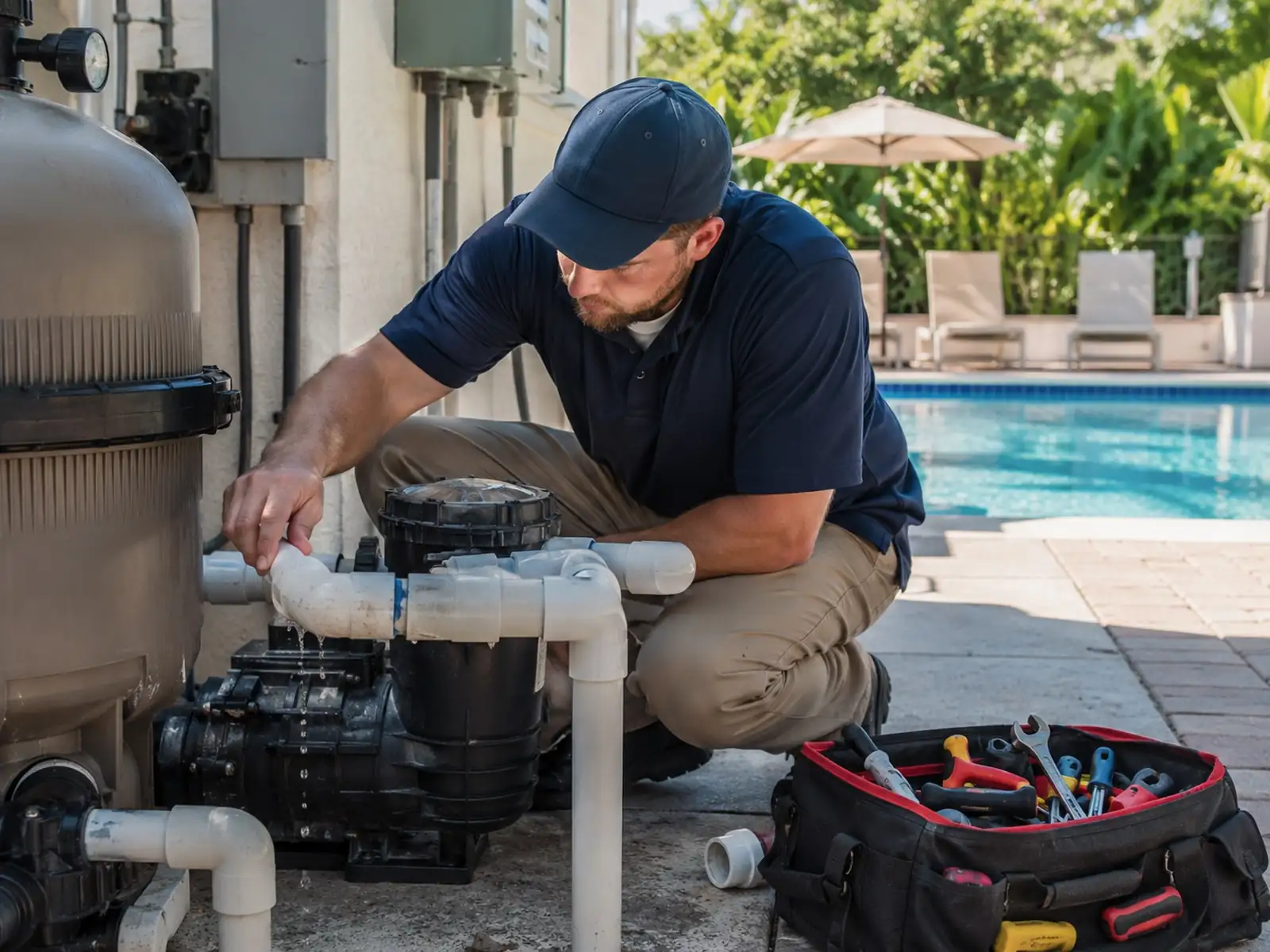
If the water is going somewhere, look at the equipment pad first, with the pump running and then with it off. A drip at a union, a valve stem or the pump's shaft seal is the cheapest kind of leak to find. See equipment-pad leak repair and pool pump leaking.
Old pool chemicals and old equipment
Chemicals. Pool chemicals are household hazardous waste and don't go in the trash cart. Queen Creek residents with active Town trash and recycling service can take them to the Town of Gilbert's household hazardous waste facility at 2224 E. Queen Creek Road, at no extra charge, with a voucher from the Town. Pool chemicals are on the accepted list. The Town issues up to 32 vouchers a month, first come, first served; they can take up to three weeks to become available and expire two weeks after you get one. Limits are 70 pounds per vehicle and ten gallons of any one liquid, in containers of five gallons or less, and you'll need picture ID with your Queen Creek address (Town household hazardous waste page). Keep each chemical in its original, labeled container, and never mix them to "use them up".
Bulky items. Residents with an active Town trash and recycling account get a free bulk trash pickup each month. Schedule it by noon the business day before, have it at the curb by 6 a.m., and keep the pile under six cubic yards. Hazardous materials aren't accepted, so nothing that still holds chemicals goes in the pile. Extra pickups beyond the free one carry a fee.
Electricity, rebates and permits
If SRP is your electric utility, its residential rebate page says the pool pump rebate it offered in the past is no longer available, so be wary of any quote that counts on one. A variable-speed pump is still worth pricing for its running cost, which is a question about your pump, your pool and your schedule.
The Town's permit list includes swimming pools and spas, and additions or modifications to electrical systems. The list isn't complete, so if work on your pad involves new wiring or a new circuit, call Building Safety at 480-358-3003 before the work starts to ask whether it needs a permit.
Finding local businesses
The Queen Creek Chamber of Commerce keeps a public directory of local businesses, sorted by category, including pool services. It's a reasonable place to start when you need a trade that isn't ours.
When the equipment is the problem
If your pump, filter, salt system or automation isn't doing what it should, we come to the pad, find out which part has actually failed, and tell you before anything is replaced. If you don't know what's wrong, a diagnostic is $120, and it's credited toward your repair if you go ahead. Start from pool equipment repair in Queen Creek, which also covers how the age of each Queen Creek community affects its equipment, or answer a few questions in the Pool Problem Finder.
Sources
Every local fact above links to the page it came from, all checked on October 27, 2026. Rules and programs change, so check the linked page before you act on one.
- Town of Queen Creek: water FAQ, local water providers, water quality, pool draining policy, home water leak check, utility services exchange, household hazardous waste, bulk trash collection, when a permit is required.
- EPCOR, 2025 San Tan water quality report.
- SRP, residential rebates.
- Queen Creek Chamber of Commerce, business directory.
Mobile Pool Repair is not affiliated with the Town of Queen Creek, EPCOR, SRP or the Queen Creek Chamber of Commerce. They are named here only to point you to their published information.