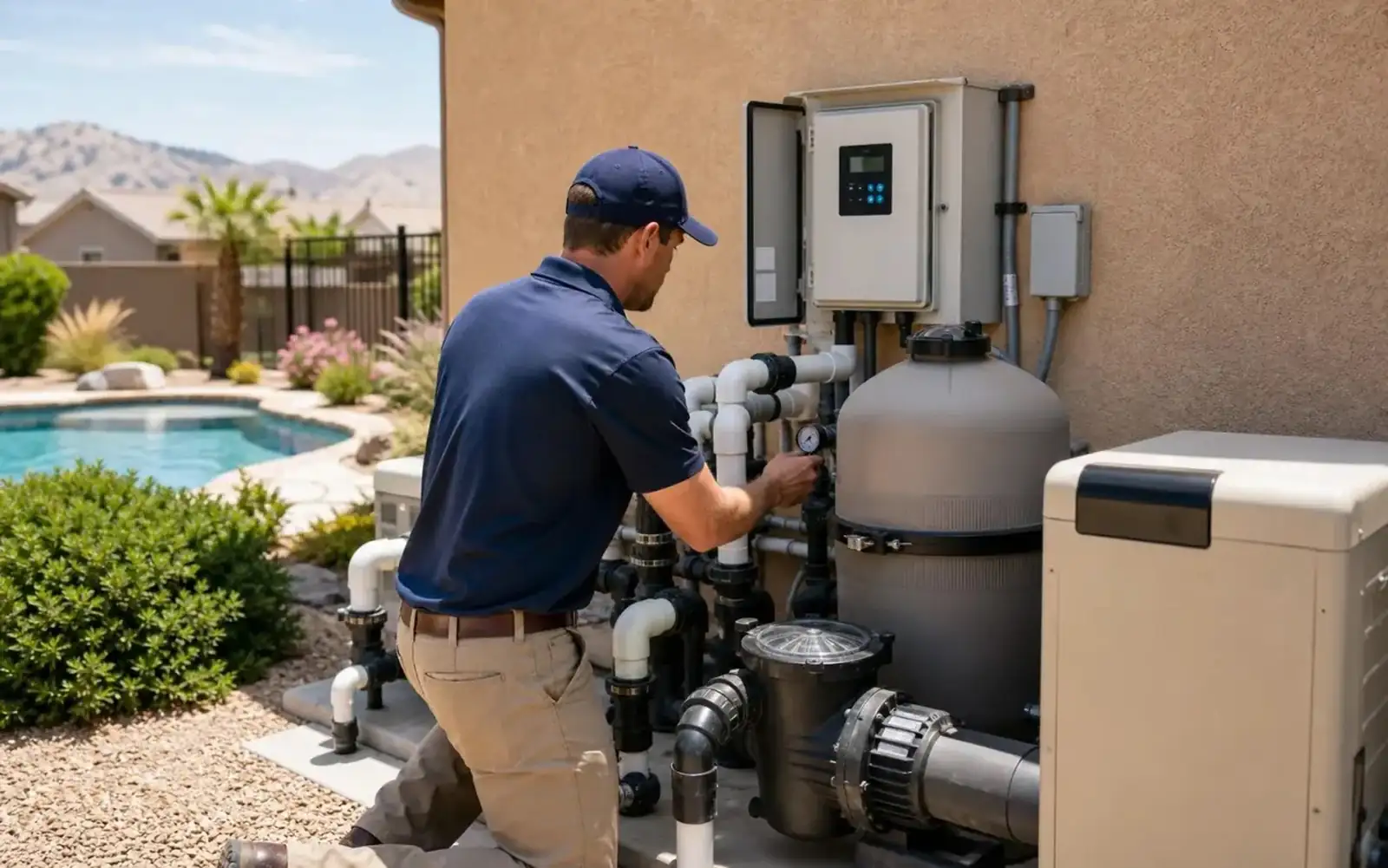
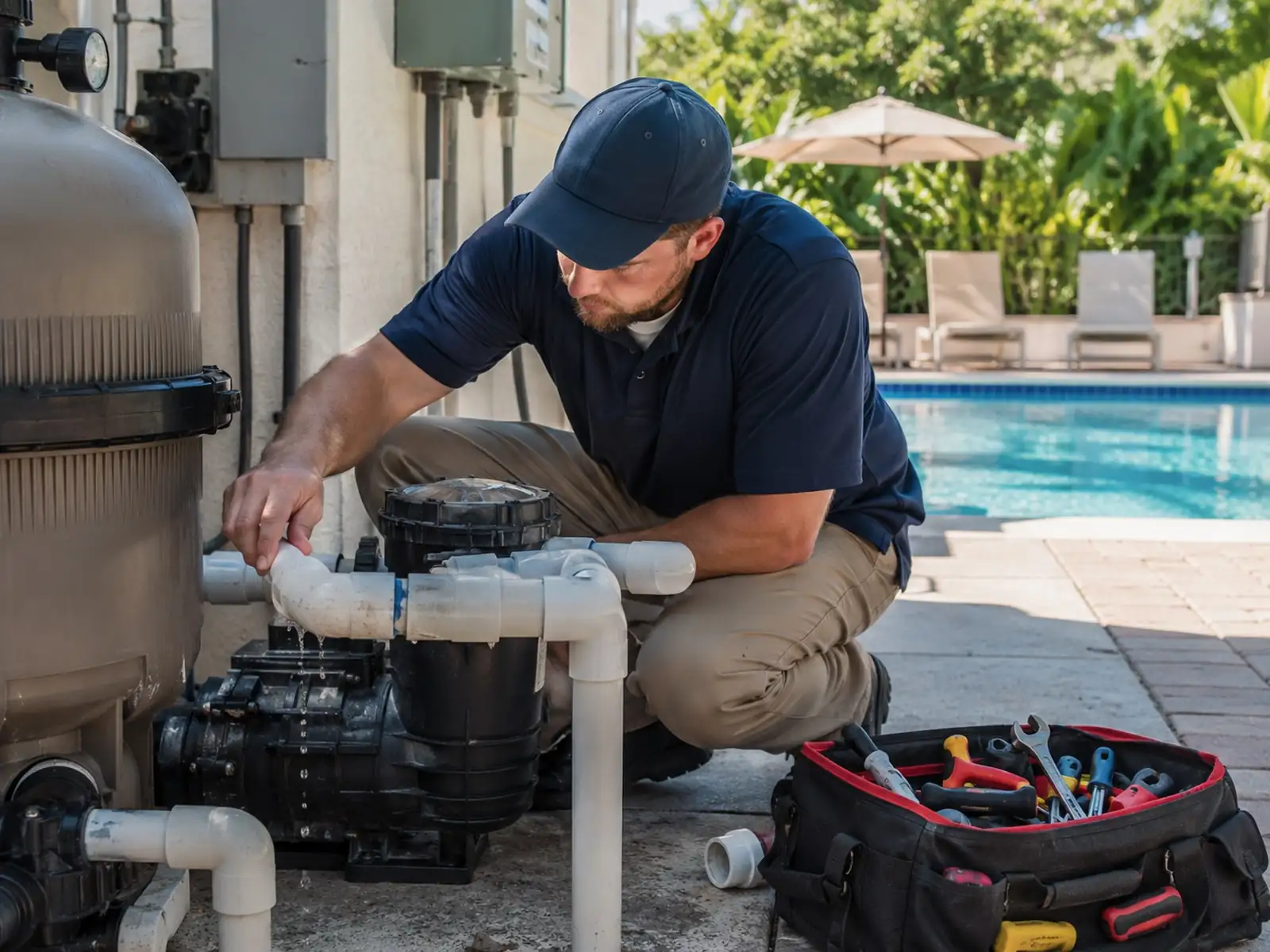

Pool pumps
Repair or replace your pool pump, and when it's just the motor
A pool pump is a wet end and a motor, and on a variable-speed pump a drive as well. Most failures are one part, and many of those parts are replaced on their own. What Hayward and Pentair say about seals, impellers and bearings, when replacing the whole pump makes sense, and the Arizona law that rules out a like-for-like single-speed motor on most pools.
$120 diagnostic, credited toward your repair · set pricing on many common repairs and installations
Most pool pumps that stop working don't need replacing. A pump is a handful of parts bolted together, and when one fails, it is usually that one part. The real question is which part has failed, what else is worn alongside it, and whether the law lets you put back what you had.
This guide goes through it the way we do at the pad: part by part, using what the manufacturers say in their own manuals.
Safety first
Turn the pump off at the circuit breaker before you open anything, not just at the timer or the keypad. Pentair also warns not to open the strainer pot if the pump has failed to prime or has been running without water in it: the pot can hold built-up pressure and scalding water. Make sure the valves are open and the pot is cool to the touch before opening it (Pentair SuperFlo guide, p. 5).
What a pool pump is made of
- The wet end is everything the water touches: the strainer housing and its lid and basket, the impeller that moves the water, the diffuser around it, the seal plate, and the shaft seal that keeps water out of the motor.
- The motor turns the impeller. Its bearings are inside it.
- The drive, on a variable-speed pump, is the electronics and keypad that control the motor.
Each of those is a separate part in the manufacturer's parts list. Hayward's TriStar VS list, for example, gives the strainer housing, basket, impeller, diffuser, seal plate and shaft seal their own part numbers (Hayward TriStar VS manual, p. 25). You can look up the list for your own pump in the Parts Finder.
Repair first: failures that are usually one part
A leak under the pump
Water dripping from between the motor and the pump body is usually the shaft seal. Both Hayward and Pentair treat it as a wear part: Hayward says shaft seals occasionally have to be replaced "due to wear or damage", and Pentair says a seal "may occasionally become damaged and must be replaced" (Hayward TriStar VS manual, p. 22; Pentair SuperFlo guide, p. 5).
Don't leave it. Hayward's troubleshooting section explains that a seal leak lets chlorinated water seep into the motor bearings and wash out their grease, and says "all seal leaks should be replaced at once" (Hayward TriStar VS manual, p. 26). A seal is a repair. A seal ignored until the bearings fail is a motor. See pool pump leaking.
Weak flow and a clean filter
A clogged or damaged impeller cuts flow even when everything else is fine. Hayward's fix for a "plugged, restricted, or damaged impeller" is to replace the impeller with a new seal assembly, not the pump (Hayward TriStar VS manual, p. 26). If the basket is full of air rather than water, the problem is more likely on the suction side. See pump running but no water flow.
A cracked lid, basket or strainer housing
These are wet-end parts with their own part numbers. A cracked lid or basket is a simple swap. A cracked housing is a bigger job, because it is part of the plumbing, but it is still not the motor.
A hum but no start
On a single-speed motor this is often the start capacitor, a small part, but it can also be a seized motor. See pump humming but not starting before anyone condemns the pump.
Where it gets closer: the motor
A grinding, screeching or whining pump that wasn't making that noise before is usually bearings. Hayward lists the causes: normal wear, rust, overheating, or chemicals damaging the seal so that water reaches the bearings (Hayward TriStar VS manual, p. 26). The bearings are inside the motor, so this is where the decision shifts from "replace a part" to "replace the motor, or the whole pump". See pump making a loud noise.
Pentair's motor care advice is worth following whichever way you go: shade the motor from the sun, keep any enclosure ventilated, keep chemicals and dust away from it, and protect it from water (Pentair SuperFlo guide, p. 5).
The Arizona rule that changes the answer
If your pump has a single-speed motor of one horsepower or more, you usually can't replace it with the same thing. Since January 1, 2012, Arizona law has required residential pool pump motors of one total horsepower or more to be able to run at two or more speeds, with the low speed no more than half the maximum, and to be run by a control that can operate them at those speeds (A.R.S. § 44-1375.02).
So when an older single-speed motor fails, the real choice is usually between a new multi-speed motor on your existing wet end, and a new variable-speed pump. That is worth pricing both ways, because a variable-speed pump comes with its own drive and controls, and can run slowly for long periods.
Variable-speed pumps: the drive and the "power end"
A variable-speed pump that shows a fault code, runs only at one speed, or stops a few minutes after starting has often lost the drive or its signal, not the motor. Read the code against the manual before deciding anything. See variable-speed pump repair.
When a variable-speed motor or drive does need replacing, some manufacturers sell it as one assembly. Hayward lists a TriStar VS "power end assembly" that includes the motor, the control interface and the wet-end internals, so it can go in without replacing the strainer housing or cutting the plumbing (Hayward TriStar VS manual, p. 25).
When replacing the whole pump makes sense
There is no single age or price at which a pump stops being worth repairing. These are the situations where we'd tell you replacing it is the better money:
- More than one major part has failed, such as a cracked housing and worn motor bearings.
- An old single-speed motor of one horsepower or more has failed. The Arizona rule means you are buying a new multi-speed motor anyway, so a complete variable-speed pump is worth comparing.
- The parts aren't available. If the manufacturer no longer lists the part you need, a repair can't be done properly.
- The pump doesn't suit the pool. A pump that has been too big or too small for the plumbing its whole life will keep failing the same way, however often it is repaired.
And when a repair is the right answer: a seal, an impeller, a lid, a capacitor, or a variable-speed drive or power end on a pump whose wet end is sound.
What it costs to find out
If you don't know what's wrong, a diagnostic is $120, and it's credited toward your repair if you go ahead. If you already know the pump needs replacing, pump installation has a set price, with the pump itself extra, and you hear the total before any work starts.
We test the motor, the drive and the wiring before anyone talks about a new pump, and we'll tell you which way we'd go if it were our pool. Start from pool pump repair or pool equipment replacement, or answer a few questions in the Pool Problem Finder.
Sources
Every manufacturer statement above links to this list. Page numbers are the printed page numbers in each document.
- Hayward Industries, 2.70 THP VS Pump Family Owner's Manual (TriStar VS), 1011786 Rev B.
- Pentair, SuperFlo High Performance Pump Installation and User's Guide, P/N 356968 Rev. C (7/31/23).
- Arizona State Legislature, A.R.S. § 44-1375.02.
Hayward and TriStar are trademarks of Hayward Industries. Pentair and SuperFlo are trademarks of Pentair. They are named here only to identify equipment.